
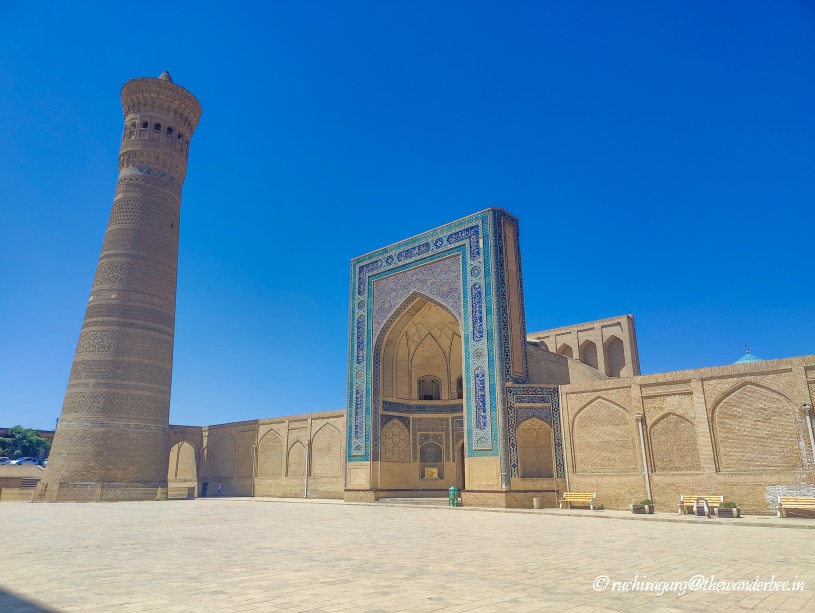
I’m heading to Uzbekistan and Kazakhstan next week!” As soon as I announced my travel plans, the person across the table choked on his coffee and, with genuine concern in his eyes, politely asked why I had chosen those destinations, especially as a woman traveler. I understood his apprehension. These countries aren’t as commonly known, but in my years of exploring, Uzbekistan has always intrigued me, particularly for its popularity among female travelers.
Despite occasional discouragement from others, the allure of Uzbekistan’s stunning azure architecture, glimpsed in countless online photos, continued to draw me. Moreover, I had heard about the country’s affinity for India and Bollywood, further piquing my interest. Eventually, I decided to take the plunge and join a travel group to explore these fascinating destinations. This blog is slightly longer as there is so much to see and know about Uzbekistan and yet not many know about it. I will share my experiences in Almaty, Kazakhstan in a separate blog.
TASHKENT:
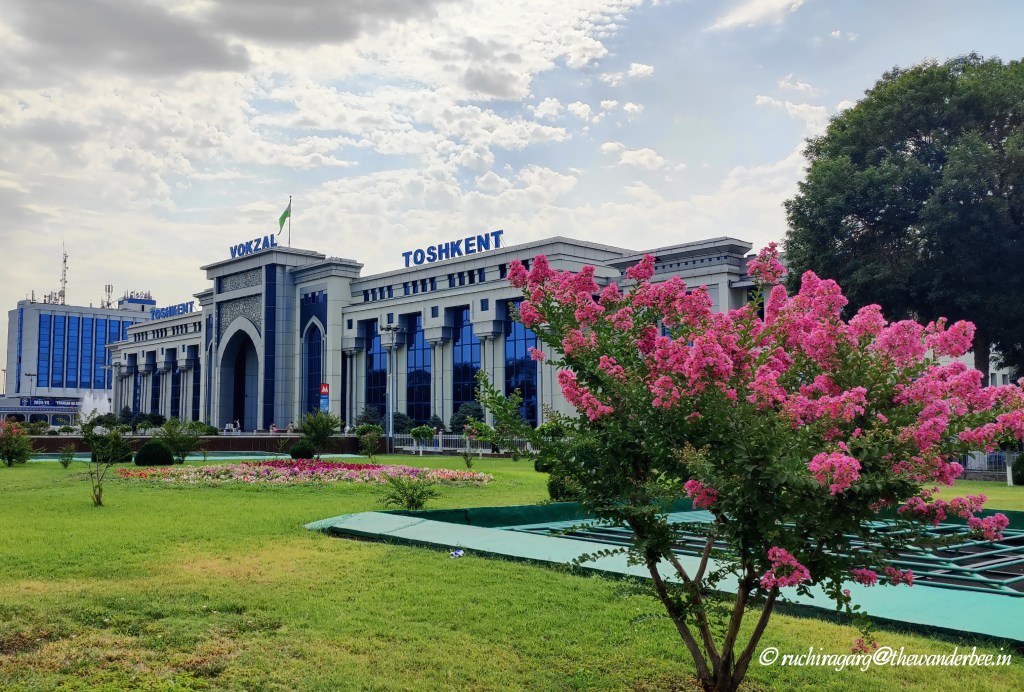
The flight to Tashkent is just 3 hours duration from Delhi. Yes, you got it right so it’s as close as Dubai and even closer than Singapore both of which are on top of every travel list. One can apply for an e-visa online through the consulate website or through visa intermediaries like Atlys. There was a problem with the captcha on the consulate website so I applied through Atlys. The visa costs just a few hundred rupees and requires very little documentation – just your ticket and passport copy.
I met some of my co-travellers at the airport as there are no direct flights from Mumbai and Bangalore to Tashkent. Uzbekistan Airways is surprisingly a comfortable airline offering full meals and snacks a well. We landed in Tashkent in the afternoon. The airport is a small international airport, and the arrival area gets very crowded if a couple of flights come together. The airport does have an ATM and foreign currency exchange counter. Would highly recommend converting currency to Uzbeki Som or withdrawing from the ATM as most places, if not everywhere we went to, accepted only cash. It took us some time to get used to the currency which was in the thousands.
Here are a few things we saw at Tashkent in our brief time there and my experiences of the same:
- The Lal Bahadur Shastri Monument:
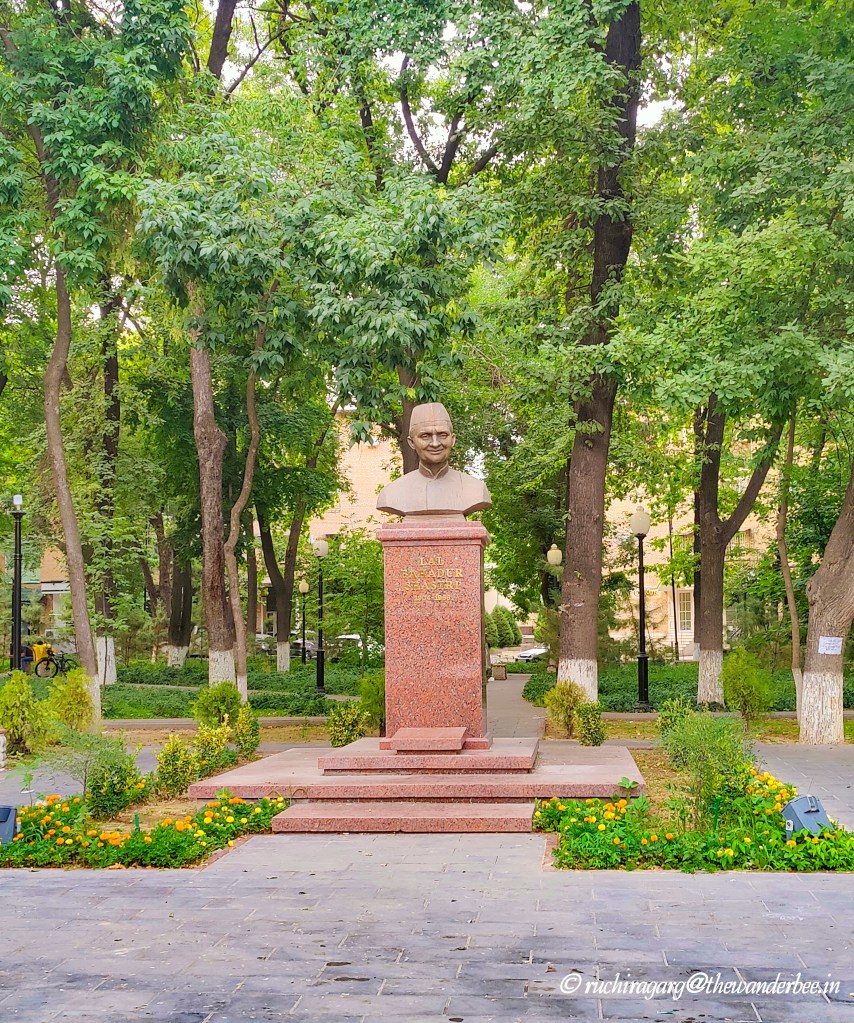
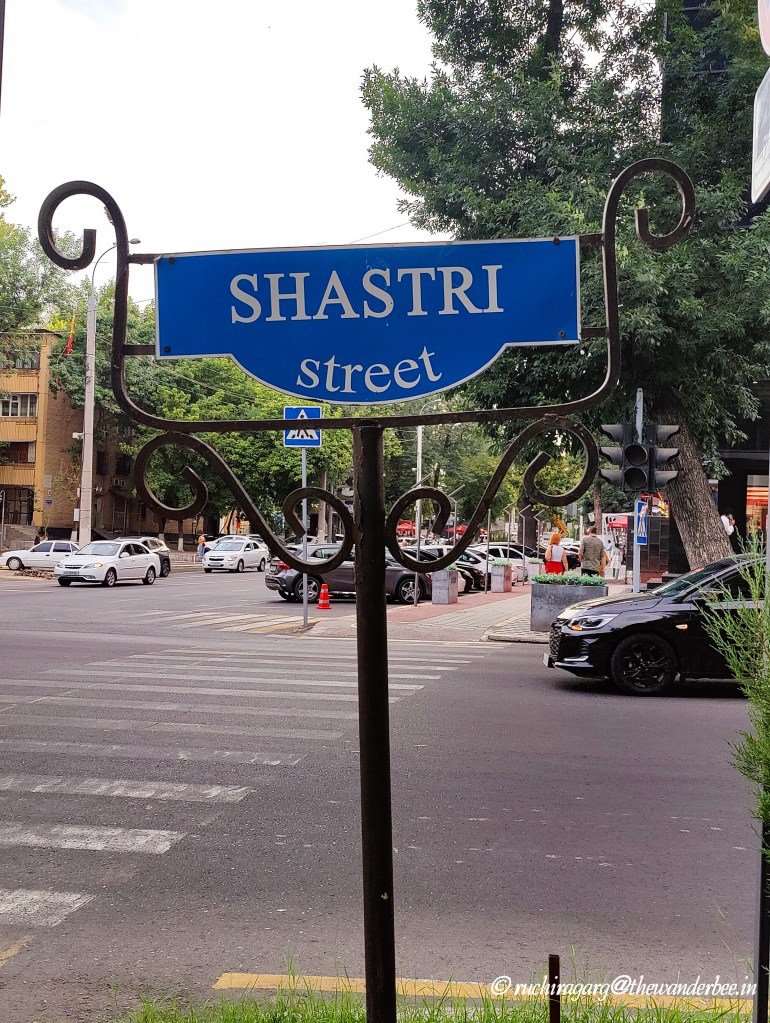
This monument pays tribute to India’s second Prime Minister, Lal Bahadur Shastri. Located in a prestigious area of the city, this memorial features a bust of Shastriji at the entrance of the park named in his honor. In January 1966, Tashkent became the pivotal site for resolving the India-Pakistan conflict, which erupted in August 1965 over the disputed Kashmir region. Lal Bahadur Shastri, then Prime Minister of India, and President of Pakistan Mohammad Ayub Khan, convened in Tashkent under the mediation of the Soviet Union to sign the historic Tashkent Declaration. This agreement committed both nations to withdraw armed forces, foster peaceful relations, and repatriate prisoners of war, among other pledges. Tragically, mere hours after signing the agreement, Prime Minister Shastri passed away under mysterious circumstances, reportedly due to a heart attack. Despite lingering conspiracy theories, including suspicions of foul play such as poisoning, the Uzbekistan government erected this memorial as a mark of respect for Shastriji. Revered in India for his simplicity, honesty, and humility, Lal Bahadur Shastri remains a beloved figure. For every Indian visiting Tashkent, the Lal Bahadur Shastri Monument is a poignant reminder of his legacy. Emotions ran deep as we reflected on one of India’s most esteemed leaders standing in front of his memorial. Adjacent to the park is Shastri Street, renowned as one of Tashkent’s posh localities, further commemorating his memory.
- Independence Square:
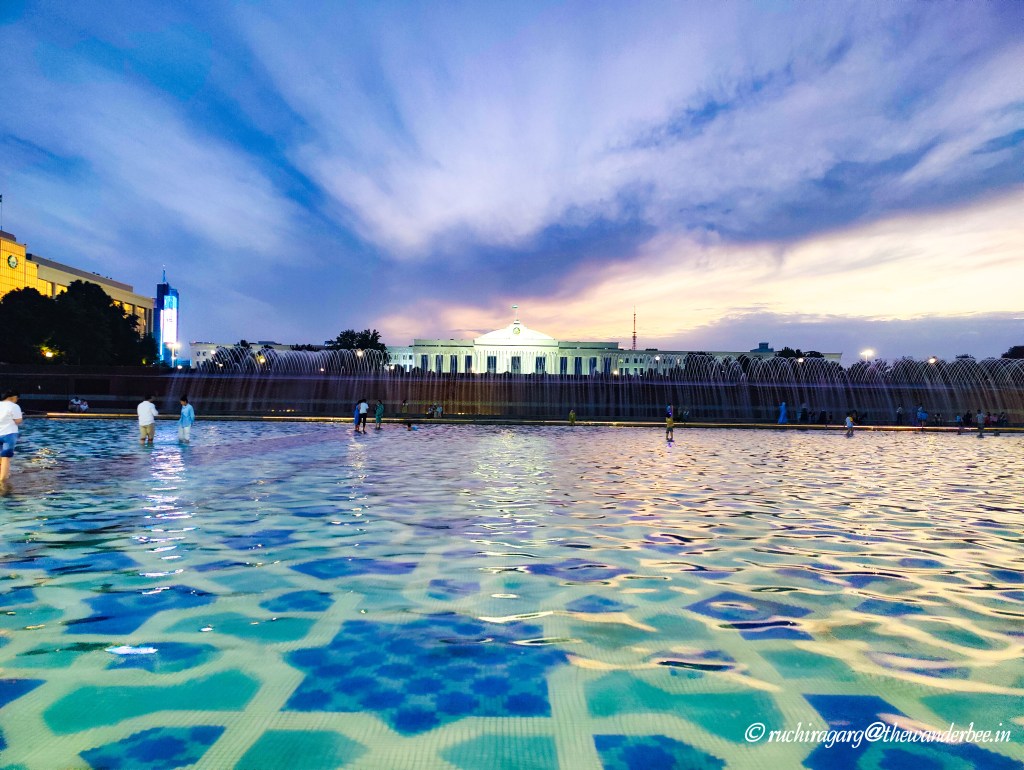
The Independence Square serves as the focal point of the country, housing the administrative offices of the Cabinet and the Senate. Rather than a typical square, it resembles a vast park adorned with numerous monuments and fountains. Surrounded by impressive governmental buildings and lush greenery, Tashkent’s Independence Square stands as a testament to modern Uzbekistan. The entrance is marked by the Arch of Independence, crowned with sculpted storks, while at the square’s center rests a bronze globe atop a granite pedestal, symbolizing Uzbekistan’s sovereignty. At the foot of obelisk stands the Monument of the Happy Mother, portraying a young woman cradling a child. Together, these monuments form a grand complex celebrating Uzbekistan’s rebirth as an independent nation. Erected in 1992, the Monument of Independence and the comprehensive renovation of the square in 2006 underscore Uzbekistan’s journey toward freedom and self-governance.
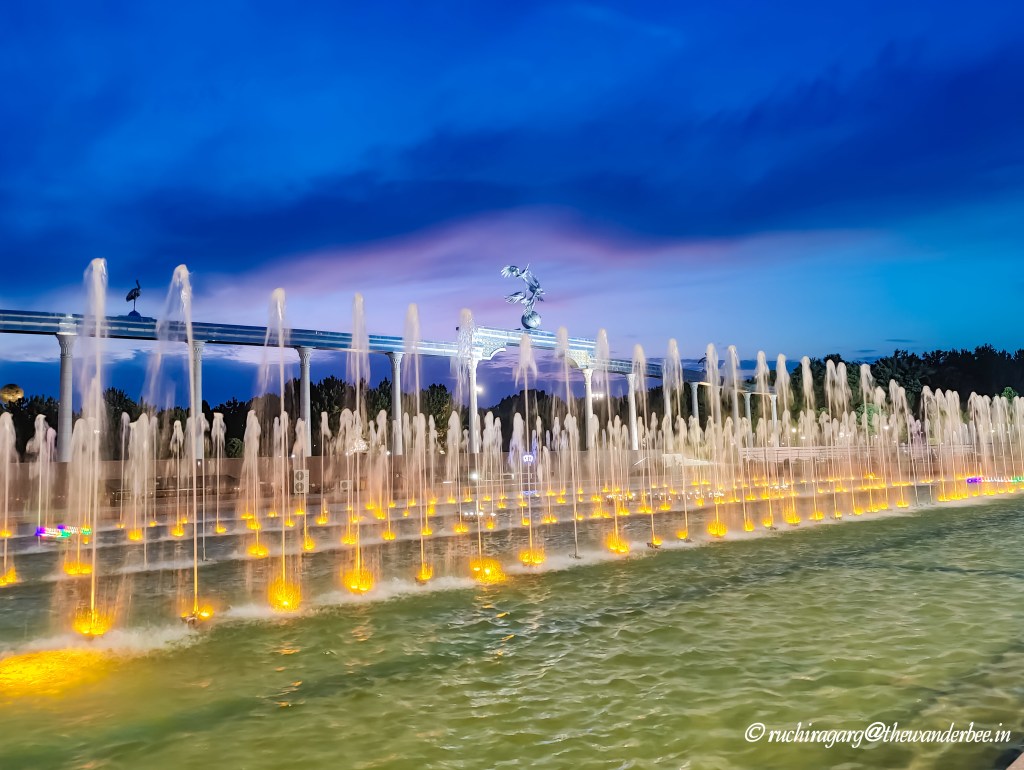
The magnificent fountains were the highlight of our trip, and we could see why they were a favorite spot for Instagram reels and photo shoots. The resplendent blue sky even at the evening hours merging with the crystal clear water of the fountains and the blue flooring served as a visual treat to the eyes.
- Khast Imam :
One of Tashkent’s revered spiritual sites is the Khazrati-Imam ensemble, affectionately known as Khast-Imam. Situated at the heart of the old city, it miraculously survived the devastating earthquake of 1966. The complex is built around the resting place of the first Tashkent Imam, Kaffal ash-Shashi, a renowned scholar and religious leader.The ensemble includes the Tillya Sheikh Mosque, the Abu Bakr Kaffal Shashi Mausoleum, the Barak Khan Madrasah, and the Imam al-Bukhari Islamic Institute. The grounds of the complex are meticulously landscaped, featuring a variety of exotic trees, shrubs, and flowers from around the world. It stands out as one of Tashkent’s most picturesque locations.
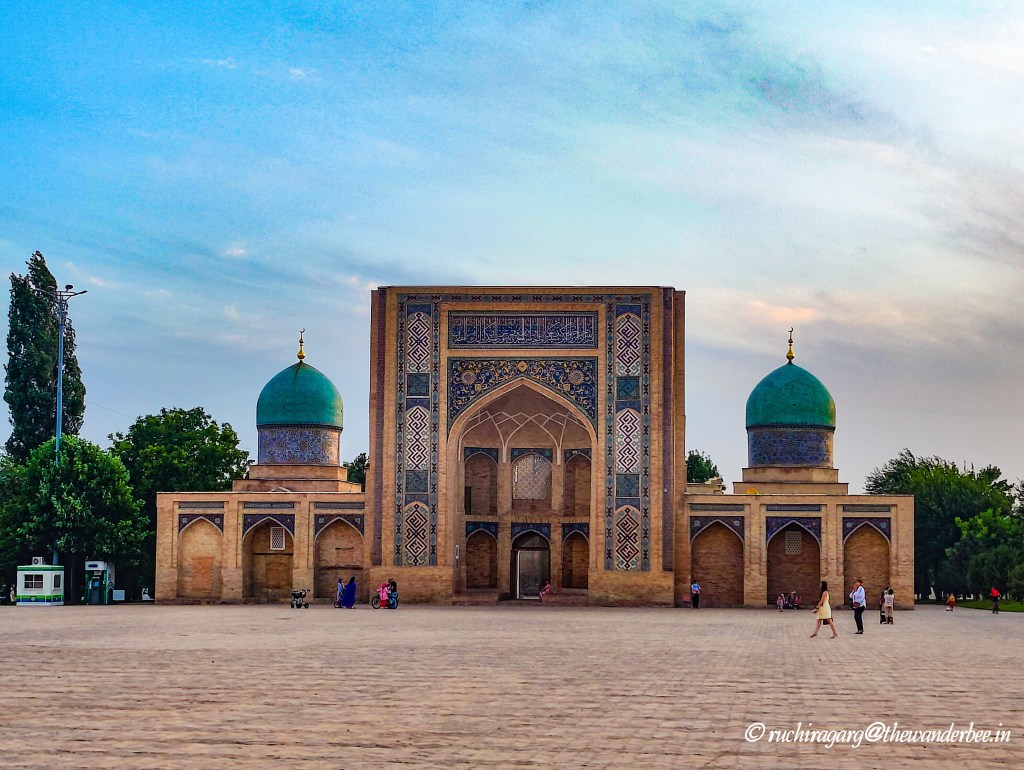
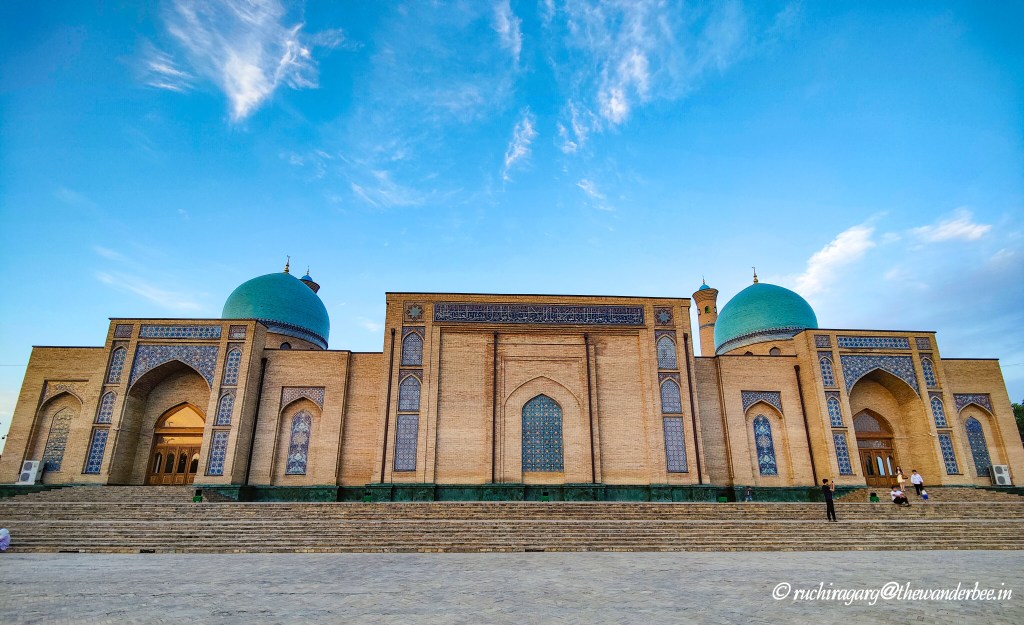
One of the most enchanting experiences here was to sit on the steps of the monuments, overlooking the grand square adorned with stunning architectural marvels. Would recommend visiting in the evening when you can appreciate the beauty both in natural daylight and under the illuminations at night which we were to experience across the monuments in Uzbekistan. This is a favorite spot for the residents as well and we were very glad to meet children who even danced to Bollywood songs for us!
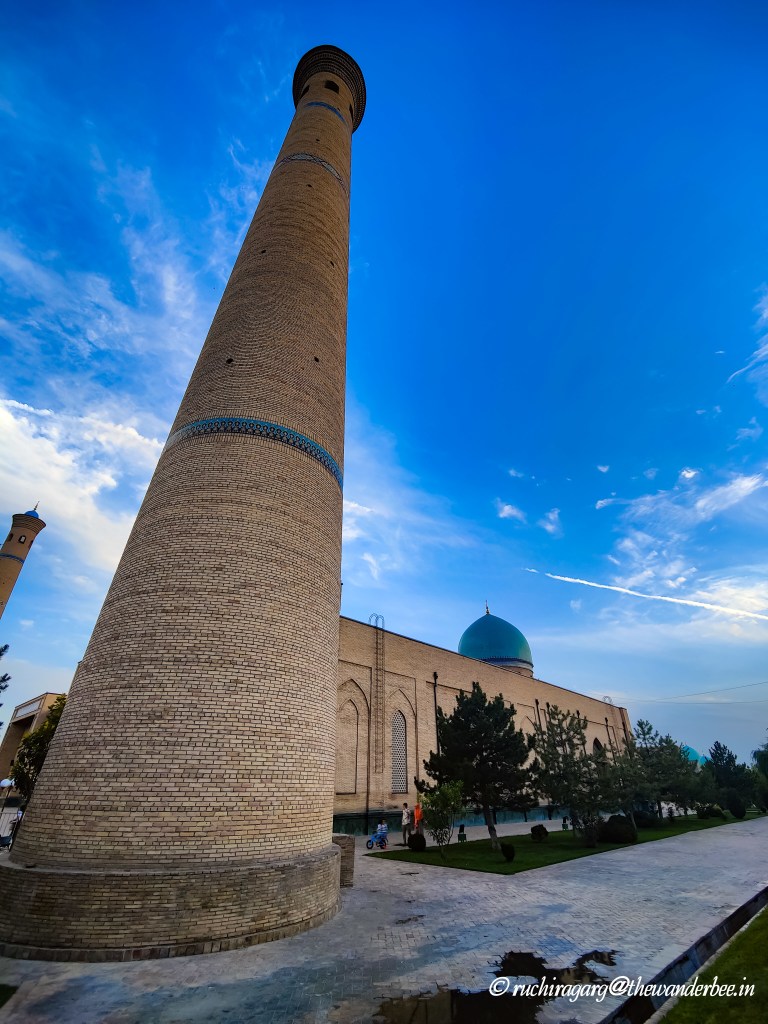
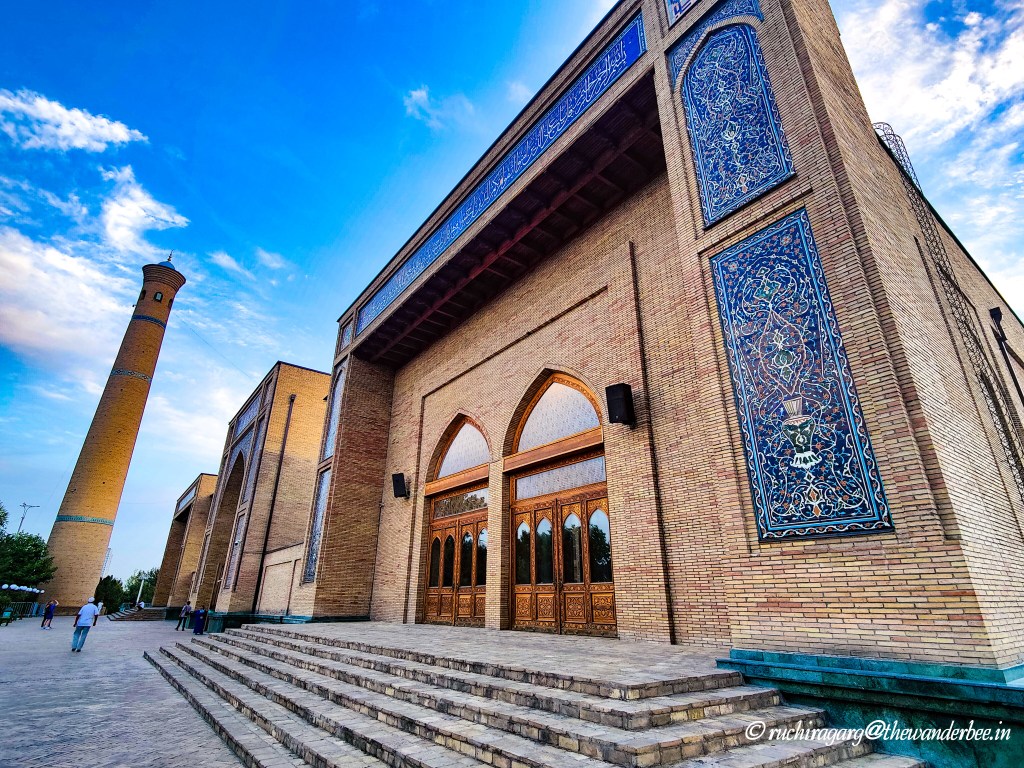
Eating places recommended in Tashkent: In our brief time at Tashkent during arrival and departure, we got to experience two Indian restaurants here. Would highly recommend the Raaj Kapur Restaurant between the two. You can click on the links below to read my detailed reviews of these restaurants.
Where we stayed in Tashkent: We stayed at Hotel Uzbekistan on our arrival for one night and I would not recommend this hotel ( click here for detailed review) . It’s an old glory and did not match up to the standards of the modern hotel chains. On our return we stayed at the Amirun Hotel ( click here for detailed review) as our flight was delayed and found it to be a decent one for a short stay close to the airport.
BUKHARA:
Our next and much awaited destination was Bukhara. Bukhara, which is situated on the Silk Route, is more than 2,000 years old and the oldest city in Central Asia. We took a train ride to Bukhara which I would not say was a pleasant journey as it was hot and sultry with the air conditioning being ineffective. It took about 6 hours to reach Bukhara by train from Tashkent. Would recommend taking a flight or driving down if possible. One can stop over at Samarkand both ways too.
However, the disappointment of the train ride was soon made up by the ambience of the historic center area where we were staying. Our hotel – Omar Khayyam though not a luxurious property was ideally located and we had no complaints. In fact they offered the best breakfast amongst all our hotels in Uzbekistan and the staff was very responsive.
The Historic Centre of Bukhara, situated on the Silk Roads, is one of the best examples of well-preserved Islamic cities of Central Asia of the 10th to 17th centuries, with an urban fabric that has remained largely intact. There are multiple hotels within the historic center, and it is largely a pedestrian only area. As we walked towards our hotel amidst the local street shops, the heritage structures all around us took us back in time. Our energy levels were restored and despite having made plans to rest that evening after the long train ride, we were all up and about to explore the city on foot.
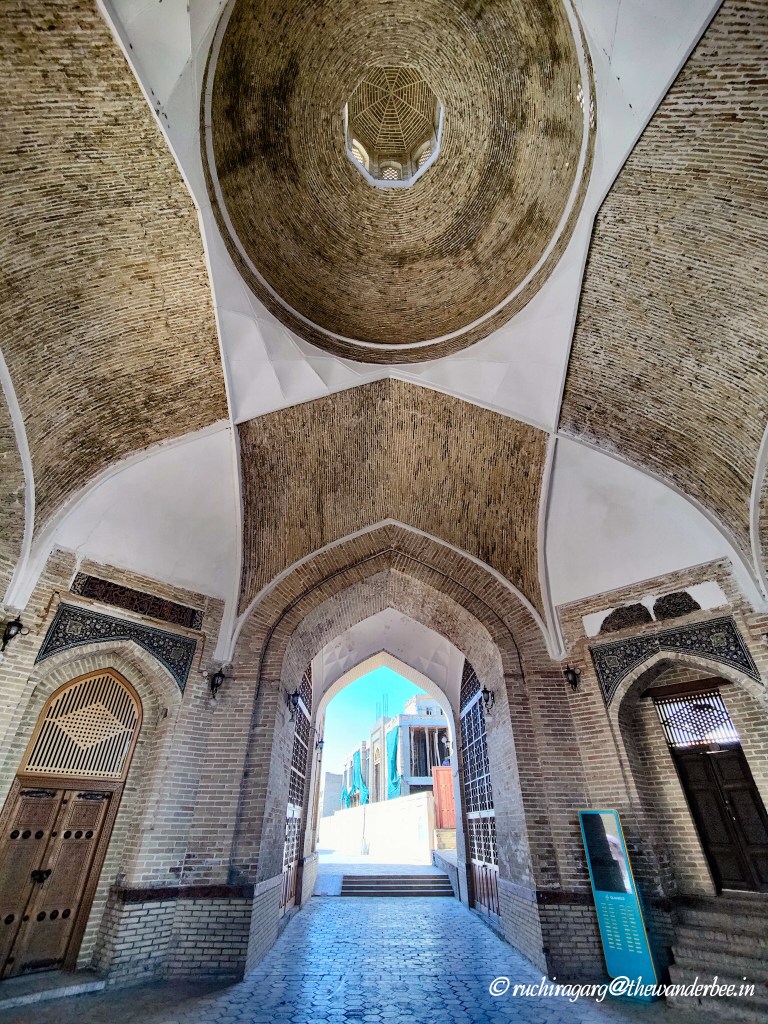
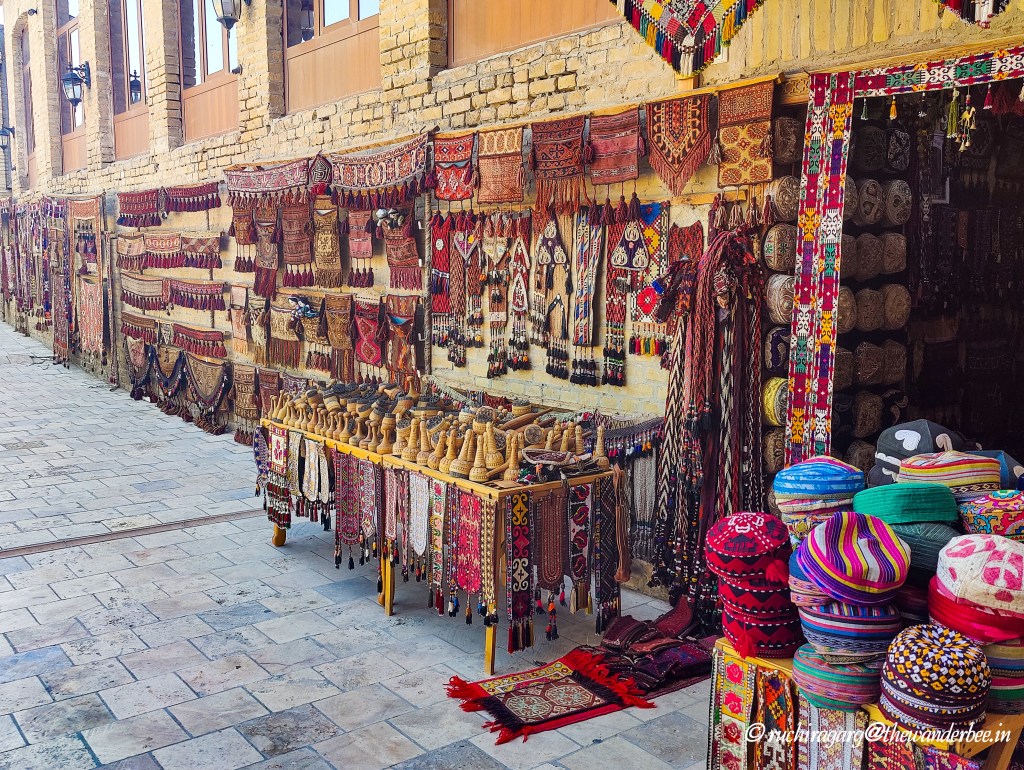
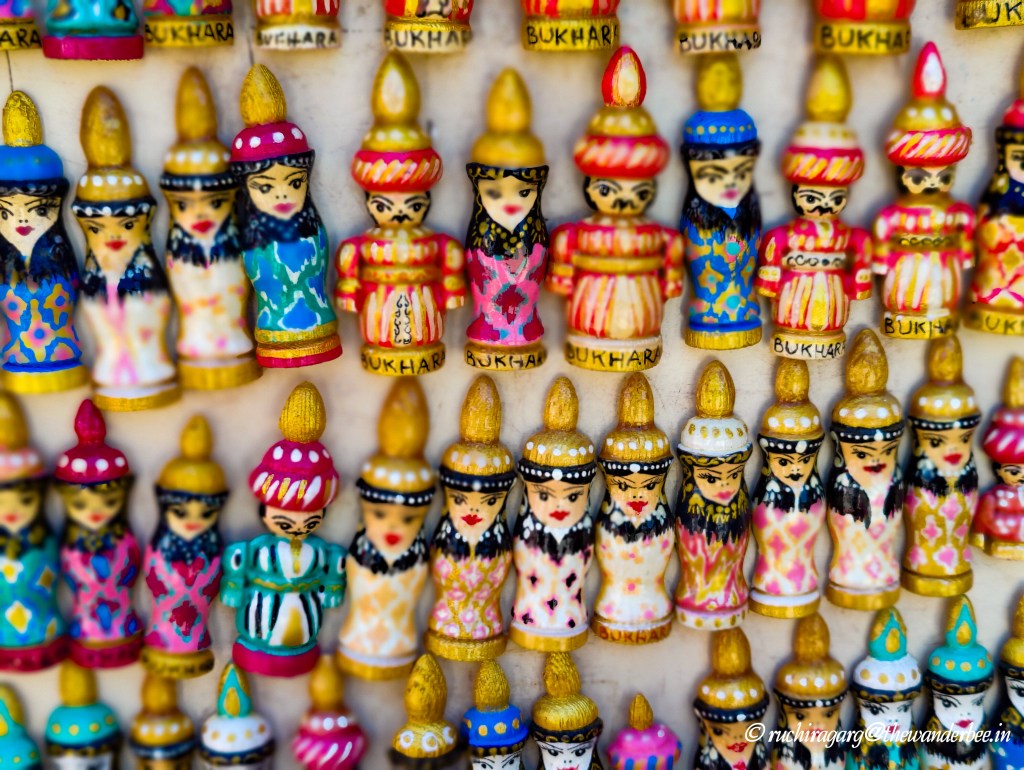
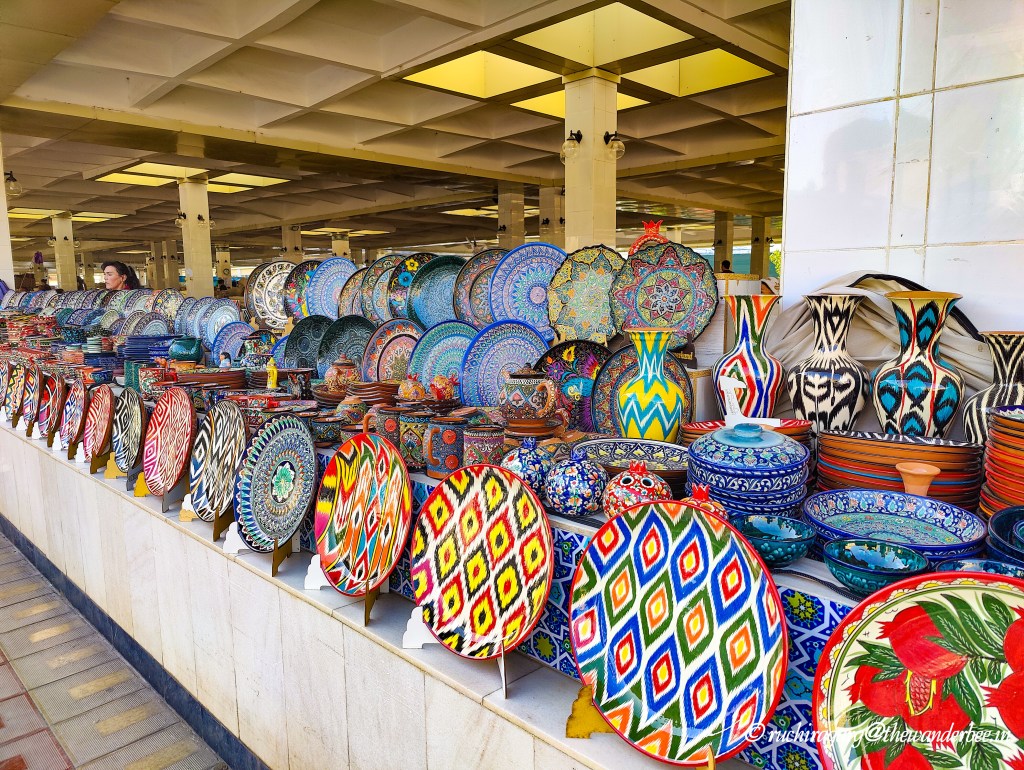
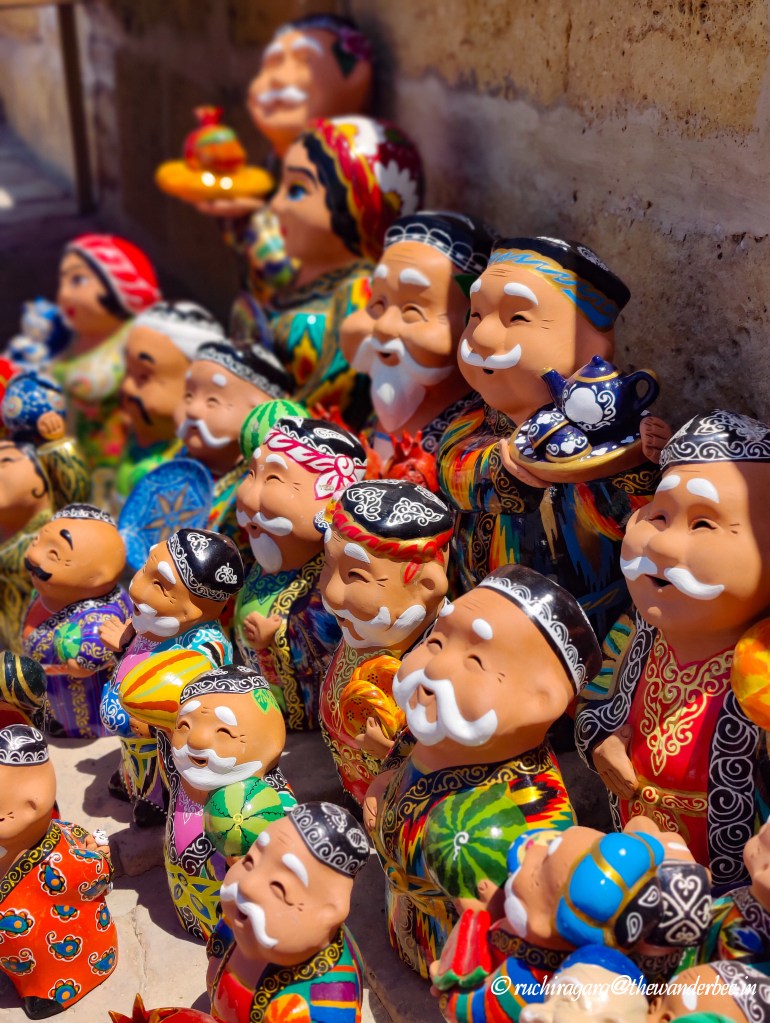
The markets in the historic center were resplendent at night. The city center was a good place to shop for trinkets, souvenirs, pottery, cotton clothes and much more and we got good bargains. There were a couple of ATMs as well near our hotel so getting cash was not a problem as all shops accepted cash only.
In our two days at Bukhara, here are the different places we visited:
- Po-i-Kalyan:
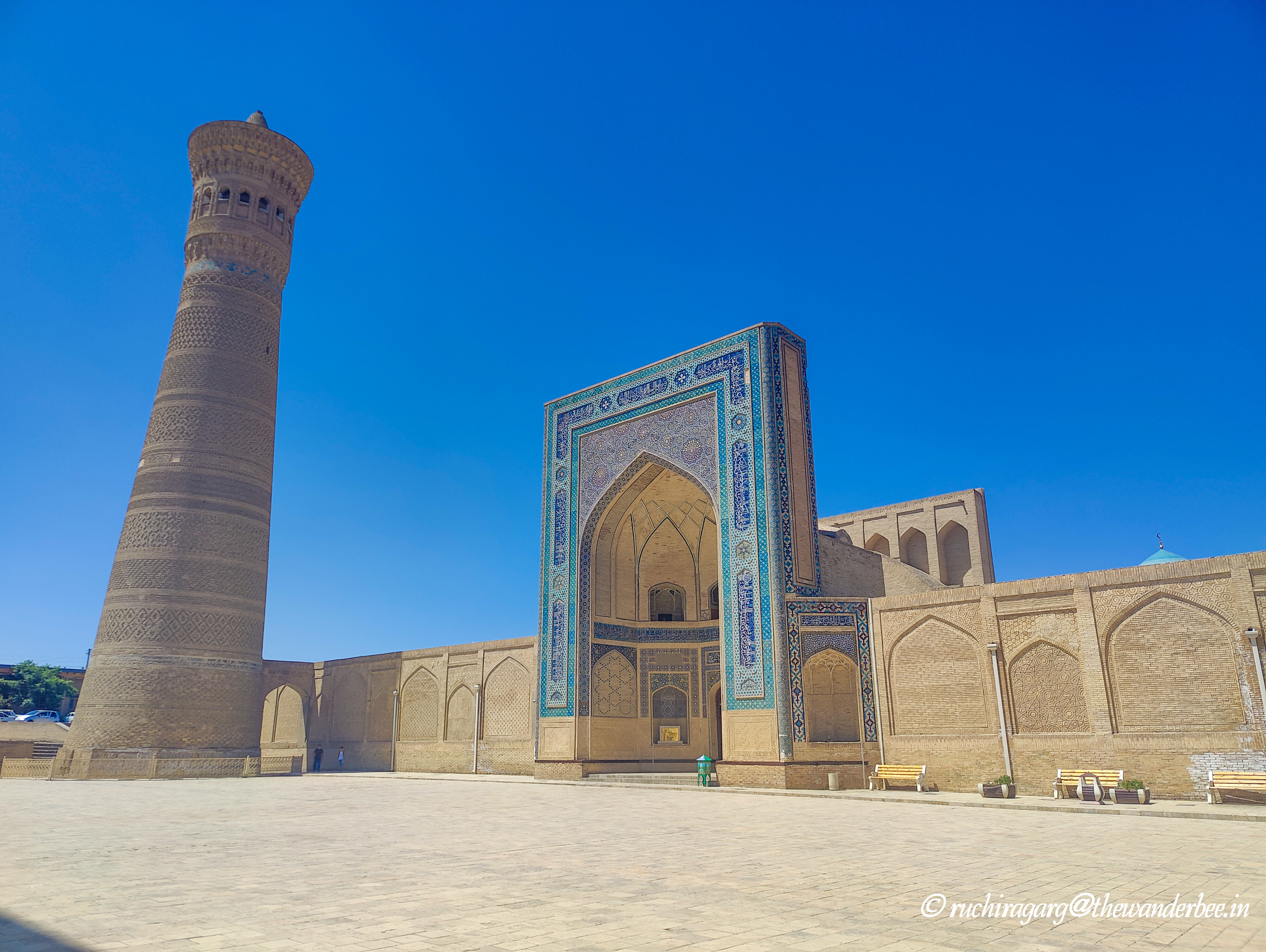
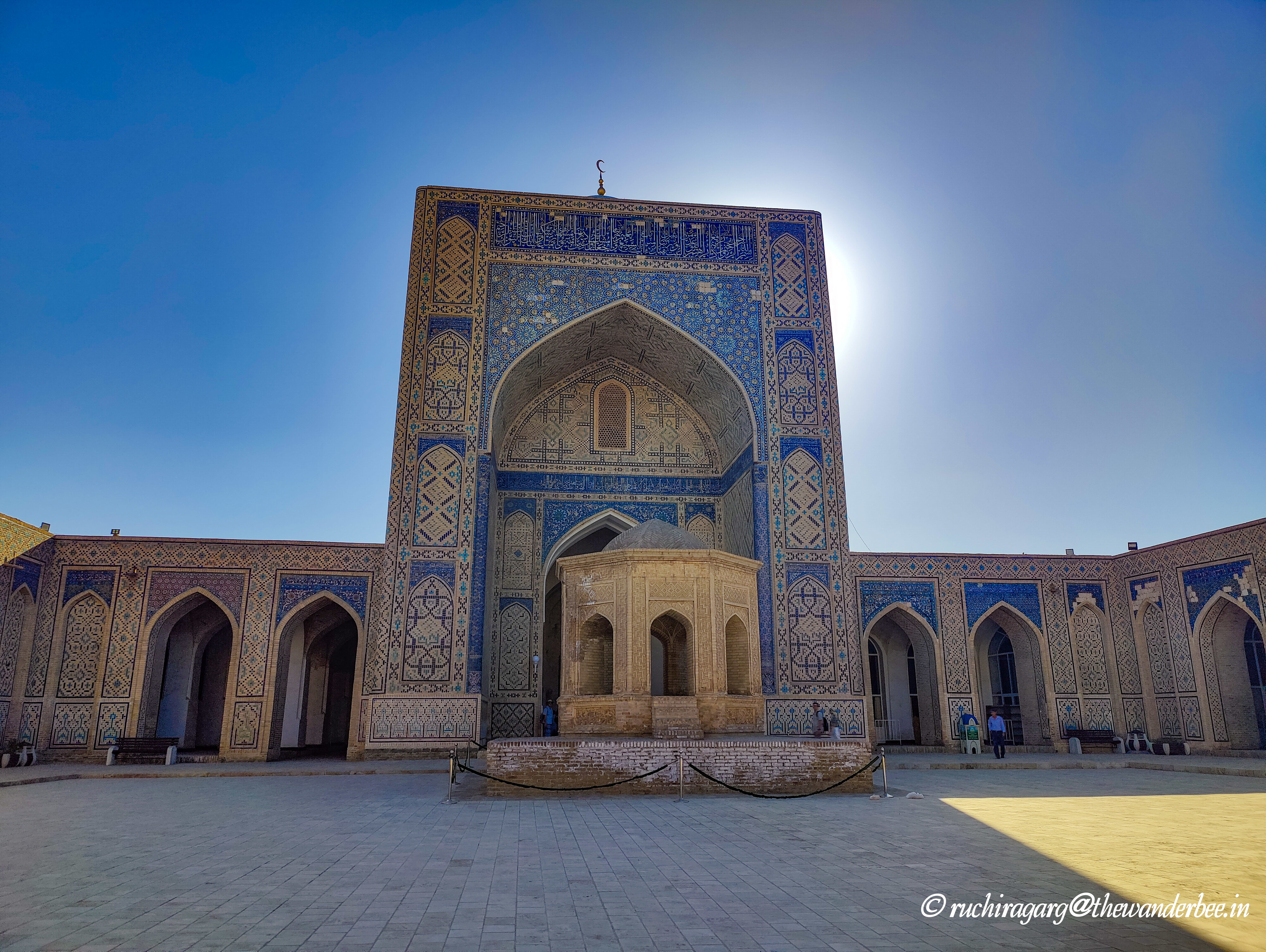
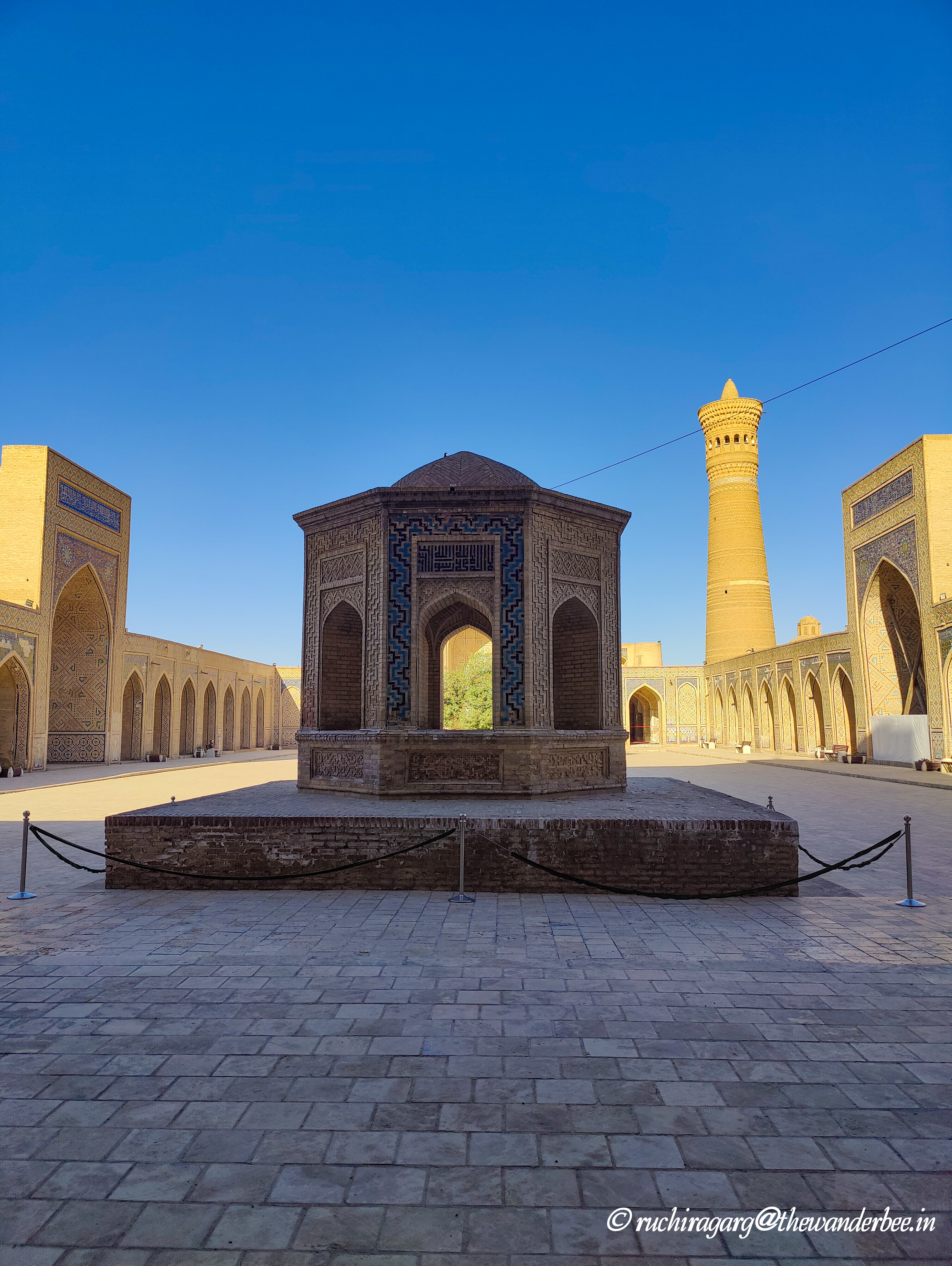

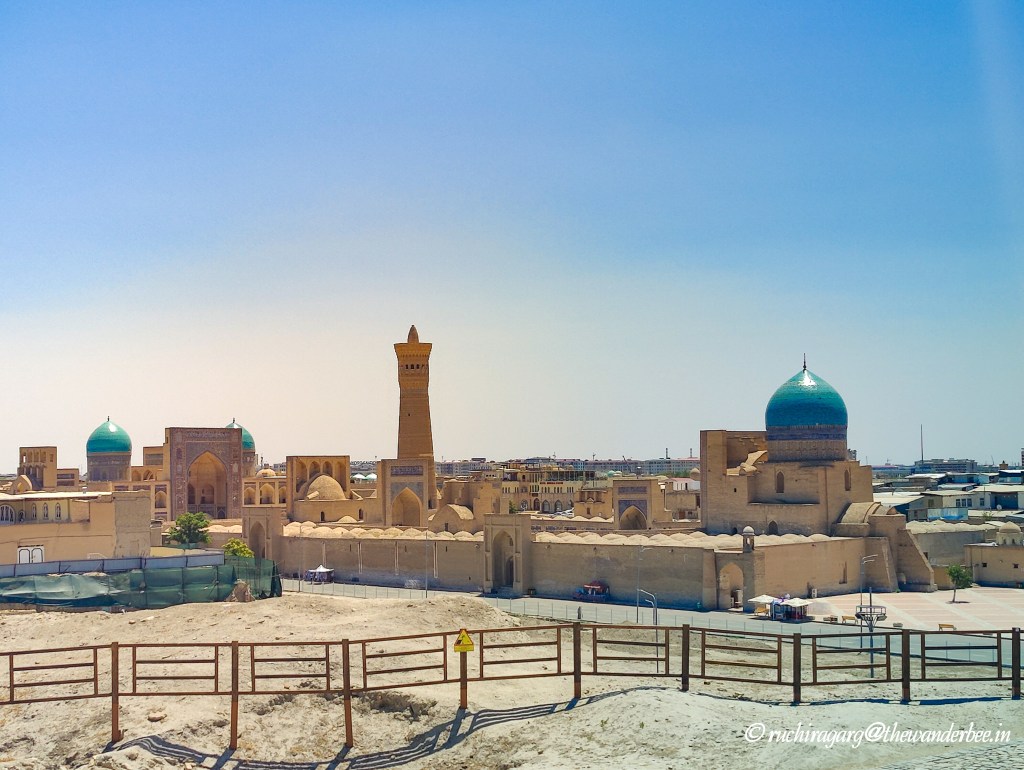
Alternatively known as Poi Kalan or Poi Kalon, it is a complex composed of three main structures: the Kalan Mosque, the Kalan Minaret, and the Mir-i-Arab Madrasah. These buildings are arranged to form a square courtyard, with the Mir-i-Arab Madrasah and the Kalan Mosque situated opposite each other. Originally, both the Kalan Mosque and Minaret were commissioned by Arslan Khan in 1121, with the construction of the renowned Kalan Minaret completed in 1127. Unfortunately, the original mosque was destroyed by Genghis Khan, leaving only the Kalan Minaret standing. In 1515 and 1535, during the reign of Shibani Khan’s nephew Ubaydullah Khan, the current Kalan Mosque and the Mir-i-Arab Madrasah were commissioned.
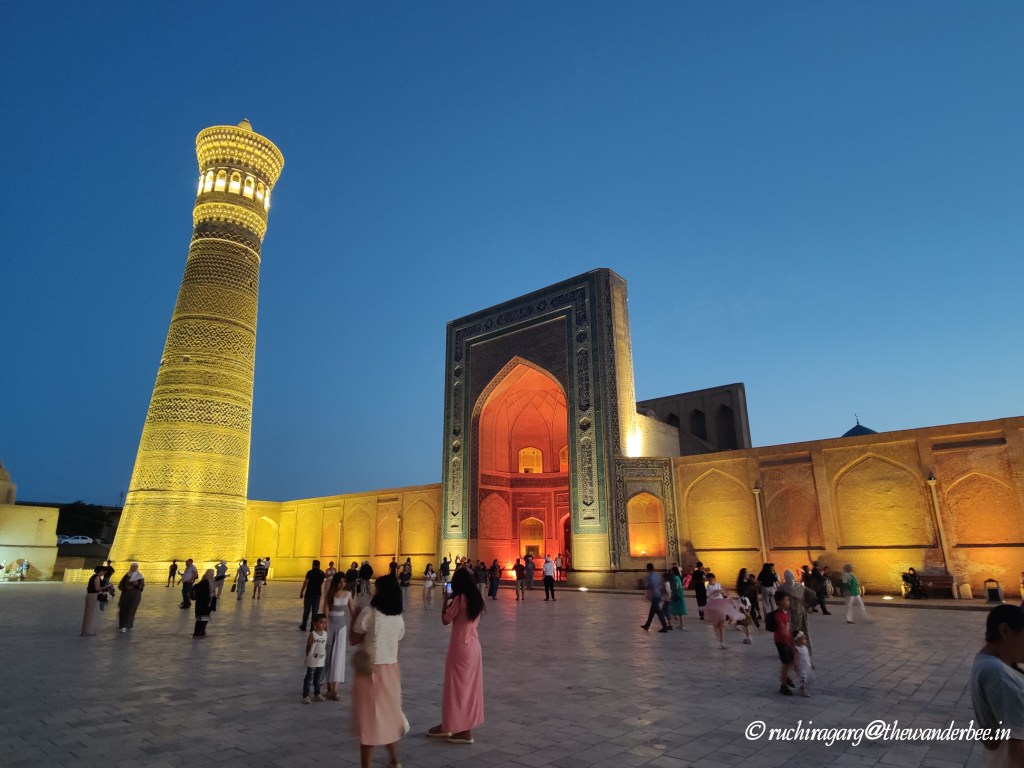
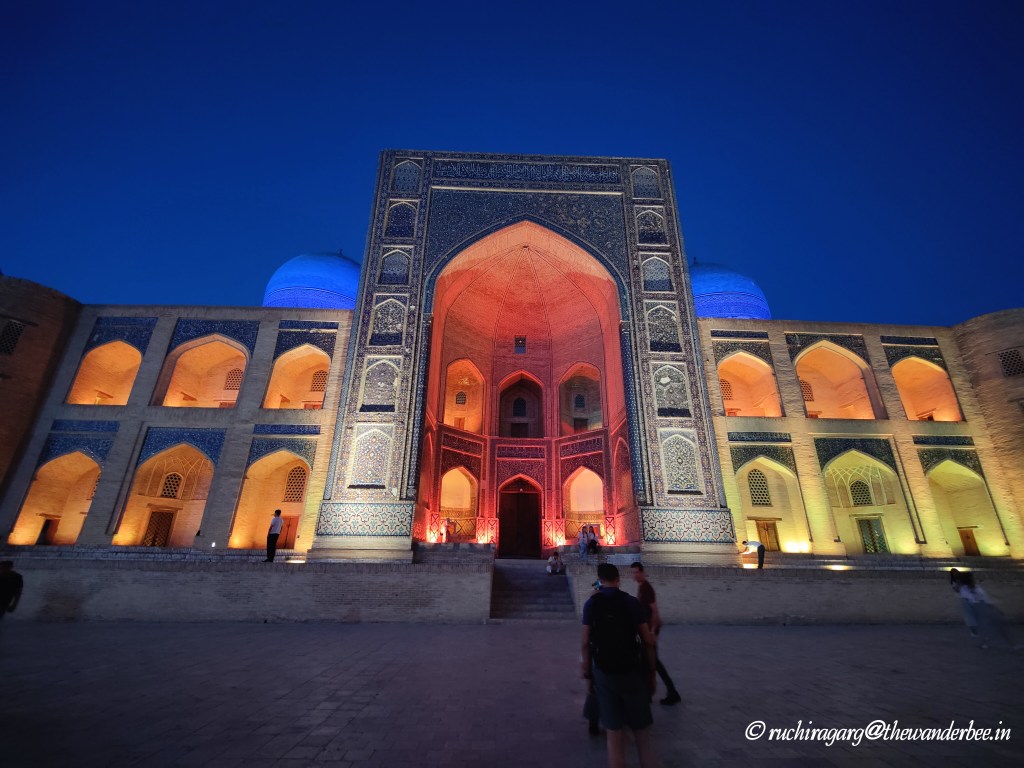
The square has a market around it and there are also a couple of hammams behind the mosque. Our hotel was a 5 minutes’ walk from the Poi Kalyan Square. The mosque, minaret and the madrasah in front of it looked majestic at night as they were beautifully illuminated with the lights and the dusky blue sky added to the ambience. No filters needed to be used to capture the beauty of the moment in the cameras. I would recommend visiting this site both during the day and night to experience the beauty in different formats. The mosque closes at 6 p.m and has a ticket for entry.
- Kunjak Bathhouse ( Hammam):
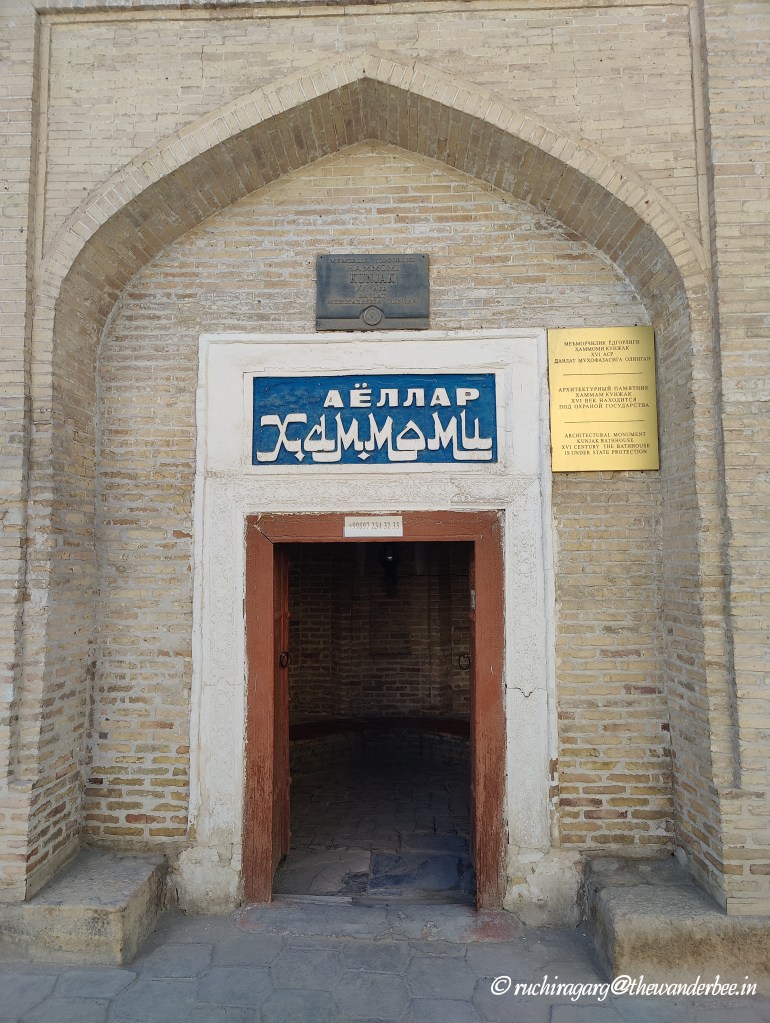
This historic and still functional hammam is situated behind the Kalon Mosque. It is the only hammam for women in Bukhara. You can visit the Hammam just to see it as well when it is not booked as it’s an architectural heritage site dating back to the 15th century. We were drawn to the unique experience of indulging in a traditional Hammam session within such a historically rich setting. Like Hammams around the world, this was an environment where modesty was left at the door. The communal experience, with its unabashed exposure, naturally facilitated lively conversations – perhaps why Hammams have a reputation of being gossip centers. Sitting across each other in full view of our bareness, the only thing that could keep one distracted, less embarrassed and stareproof was gossip. Multiple buckets of water were splashed on us as we were scrubbed, bathed and slapped all over. The ginger paste smeared all over and making us feel like marinated chicken as we felt its heat was the main differentiator from Hammam’s I have experienced in Morocco and Turkey. The massage was a quick affair and for all those readers who expect a Hammam to be a spa-like experience I would like to remind that it is essentially a bath house and the focus is more on cleaning than a massage and relaxing. Afterward, glowing from the experience, as we sat together sipping our green tea, we understood why Hammams are renowned as places for bonding. We found a renewed sense of self-acceptance. Shedding inhibitions and sharing this unique journey created a strong camaraderie among our group.
- Ulugbek Madrasah and Abdulaziz Khan Madrasah:
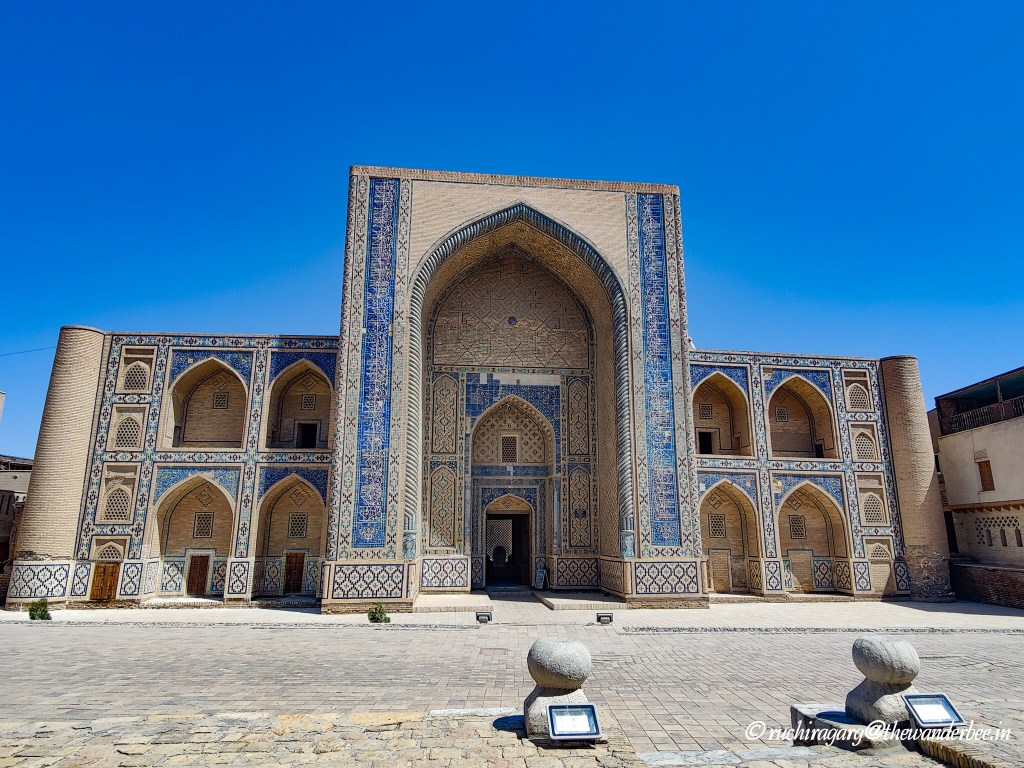
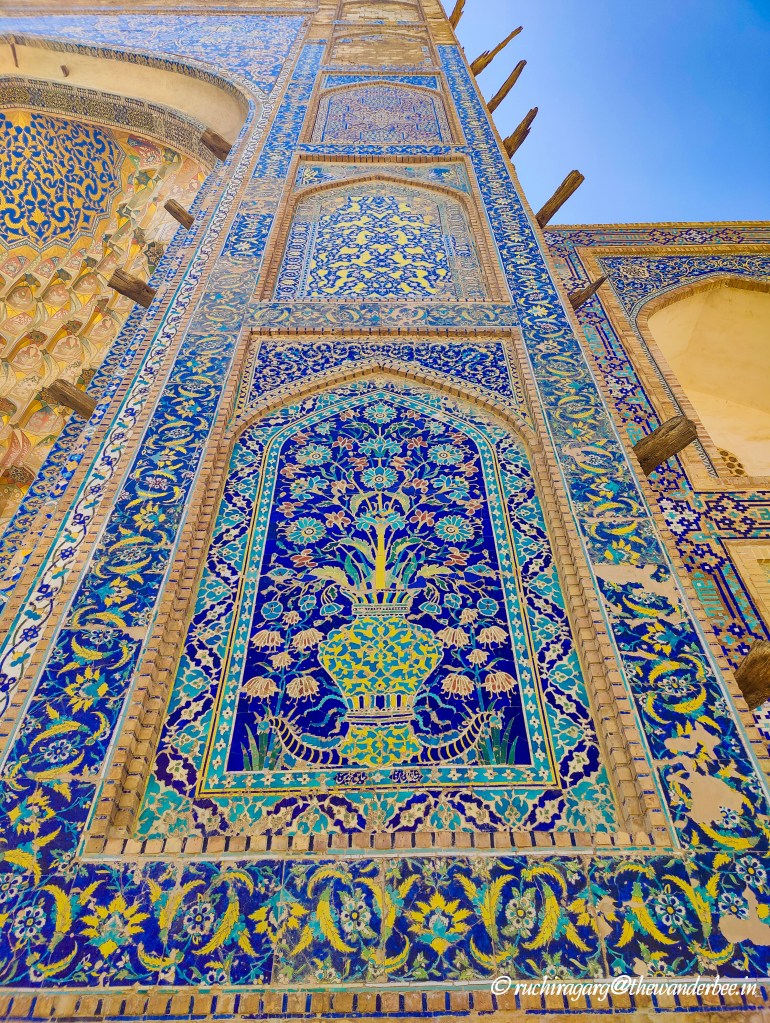
These two Madrasahs located very close to the Poi Kalon together form a single architectural ensemble. In the architecture of Central Asia, the paired ensemble of two buildings facing each other is defined by the term “double”, and the term “double madrasah” refers to two madrasahh. Currently, the Ulugbek madrasah houses the Museum of the History of the Restoration of Bukhara Monuments.
- Lyabi Hauz :
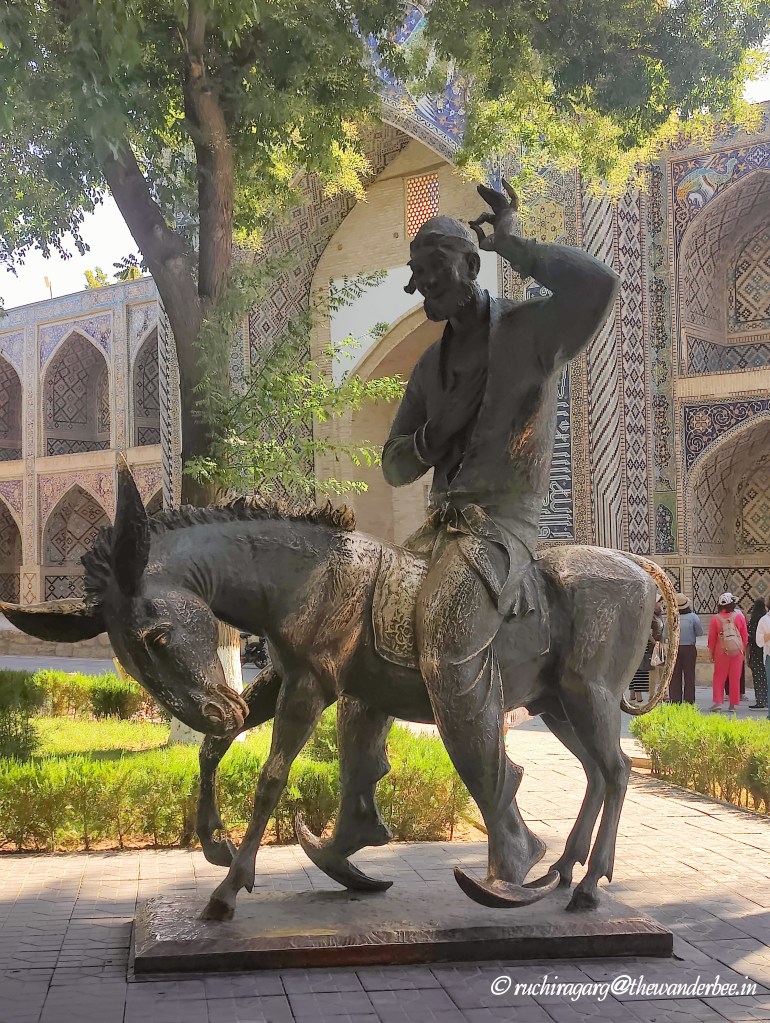
This is the area surrounding one of the few remaining hauz pools that have survived in the city of Bukhara. In the evenings, it transforms into a vibrant hub with eateries and kiosks lining its perimeter. Adjacent to the pool, you’ll find a park featuring a statue of Khoja Nasreddin, a beloved figure in Muslim folklore spanning from the Balkans to China. Nasreddin is renowned for his witty and sometimes sage-like persona, often depicted as a humorous or wise fool in countless tales and satirical anecdotes. I would recommend having dinner at one of the restaurants surrounding the pool but the kiosks next to the pool are not recommended as the service was slow and the food was not that great.
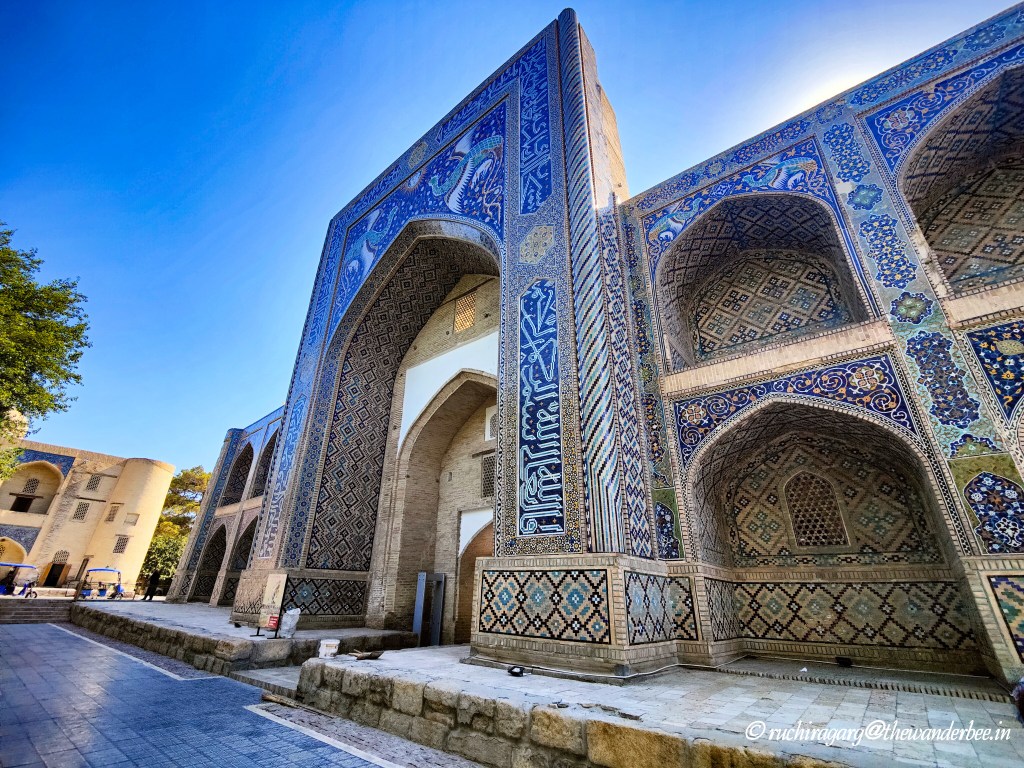
- Nadir Divan-begi Madrasah:
This was the most notable monument in the Lyabi hauz area. The madrasah was built is 1622. It is no more functional and is lined by shops selling clothes and souvenirs. One can get great bargains on cotton clothes here. We visited this area both during the day and night to see the illuminated madrasah which was a sight to see.
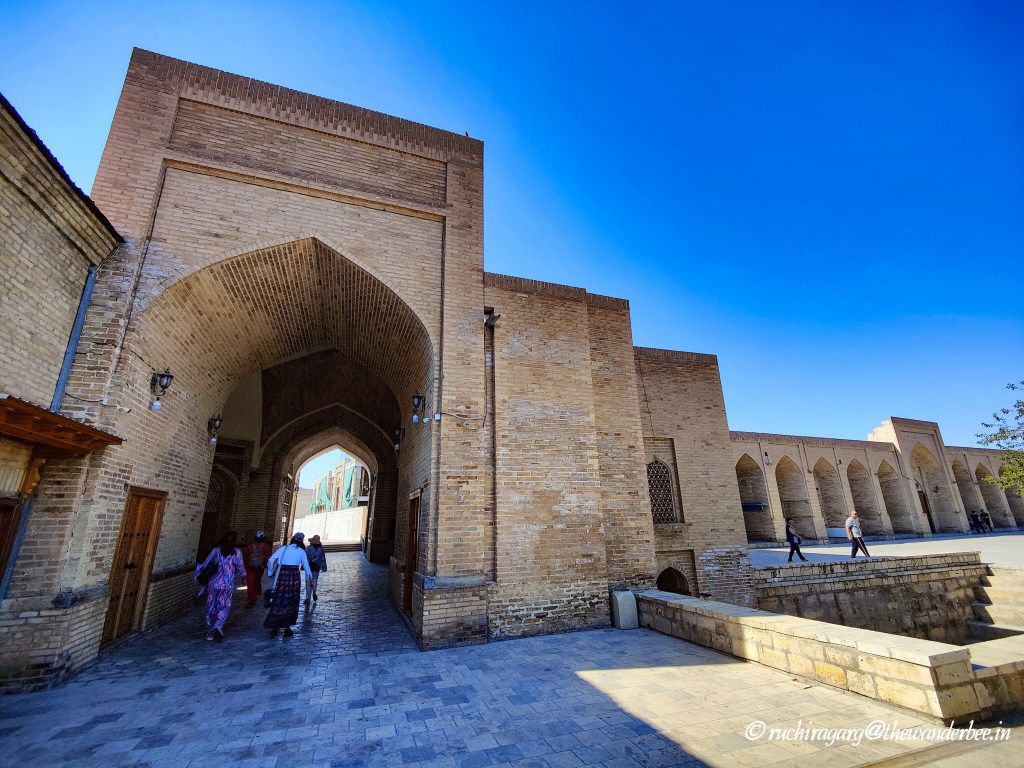
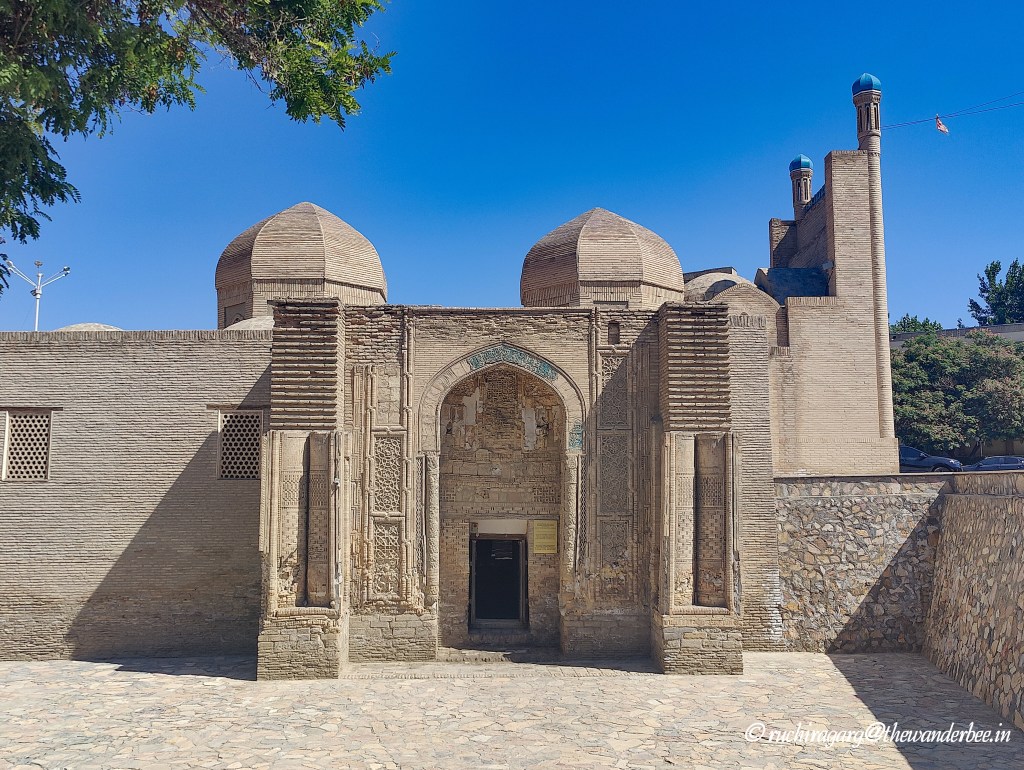
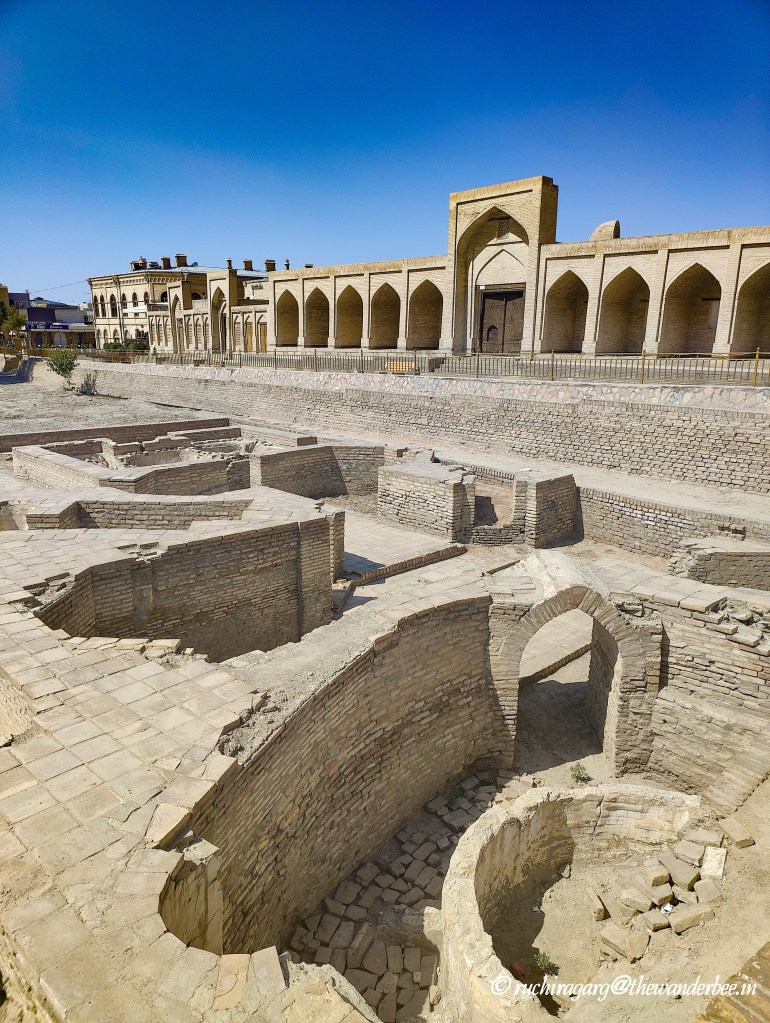
- Magolki Attor, Karavan Sarai and ruins of old hammams :
These monuments are right outside the Lyabi Hauz area. The Magolki Attor is the oldest mosque of Uzbekistan which has now been converted into a carpet museum.
- The Ark :
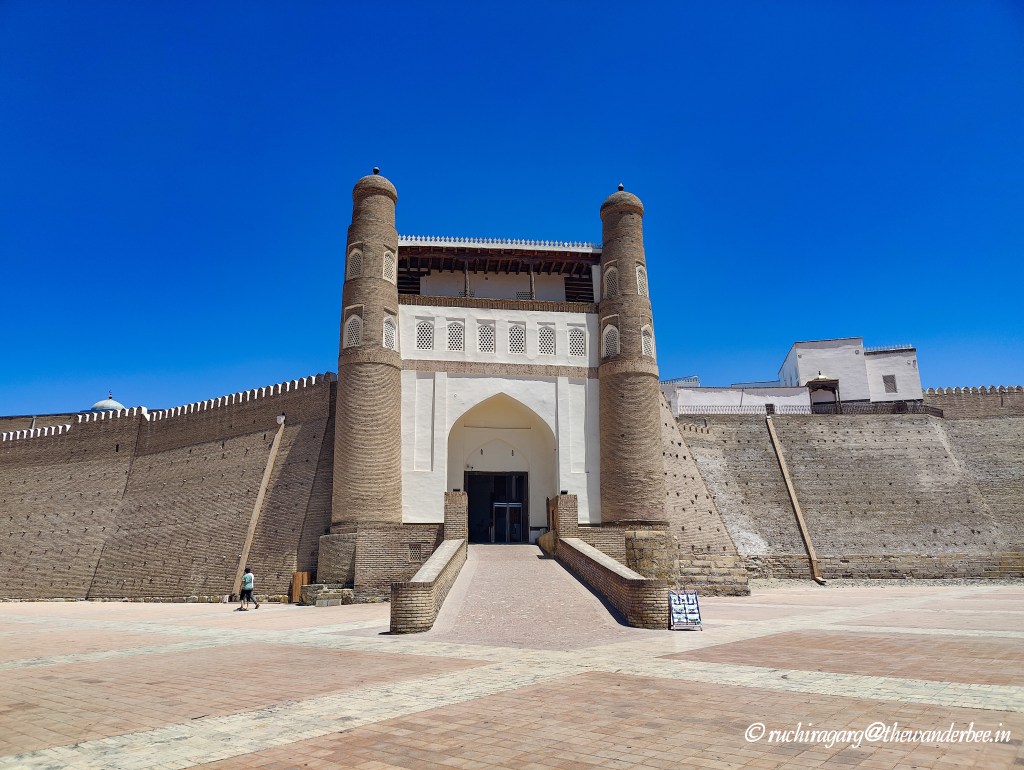
Our next stop about 10 minutes walk away from the Kalon Mosque was the Ark, a massive fortress which first constructed and inhabited around the 5th century AD. Beyond its military functions, the Ark functioned as a self-contained town, serving as the residence for numerous royal courts that governed the surrounding Bukhara region throughout its history. It remained a formidable fortress until it was captured by Russia in 1920. We visited the museums inside the Ark which gave us further insight into the history and customs of Uzbekistan.
- Bolo Hauz Mosque :
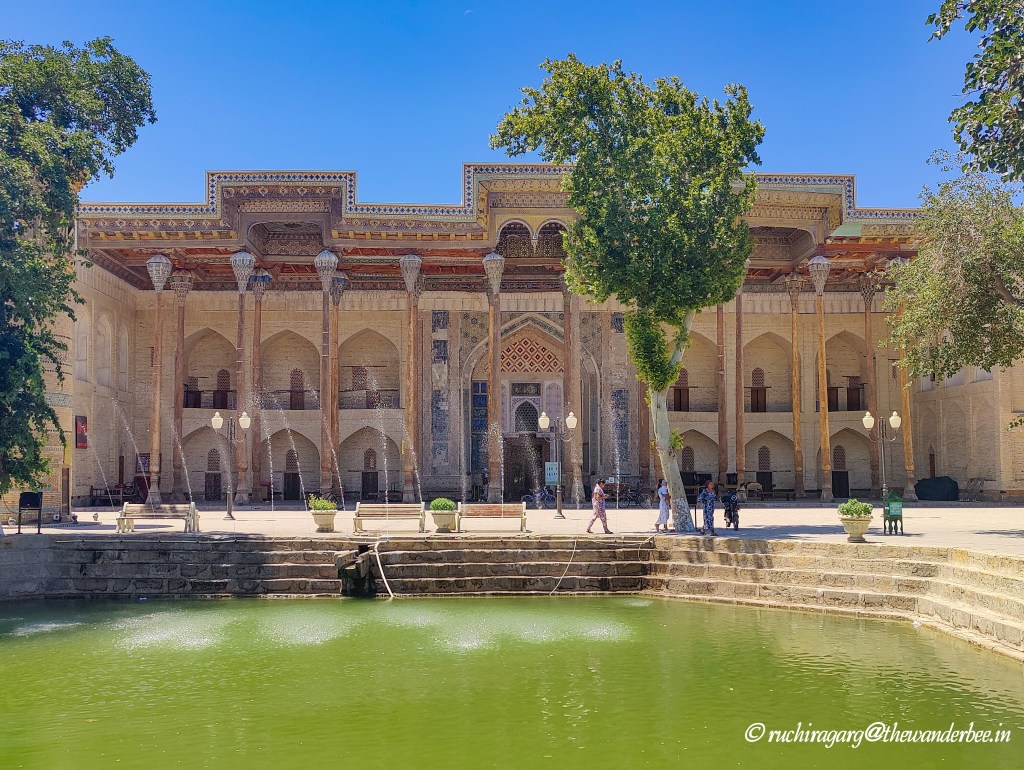
Situated across from the Ark Fortress, Bolo Hauz Mosque derives its name from the octagonal pool or ‘hauz’ in Uzbek located just in front of it. In ancient times, when water scarcity was common in the region, these ponds served as vital public water sources. Constructed in 1712, Bolo Hauz Mosque stands as one of the final architectural marvels before the modern era and continues to serve its original purpose today with being fully functional.
- Ismail Samani Mausoleum :
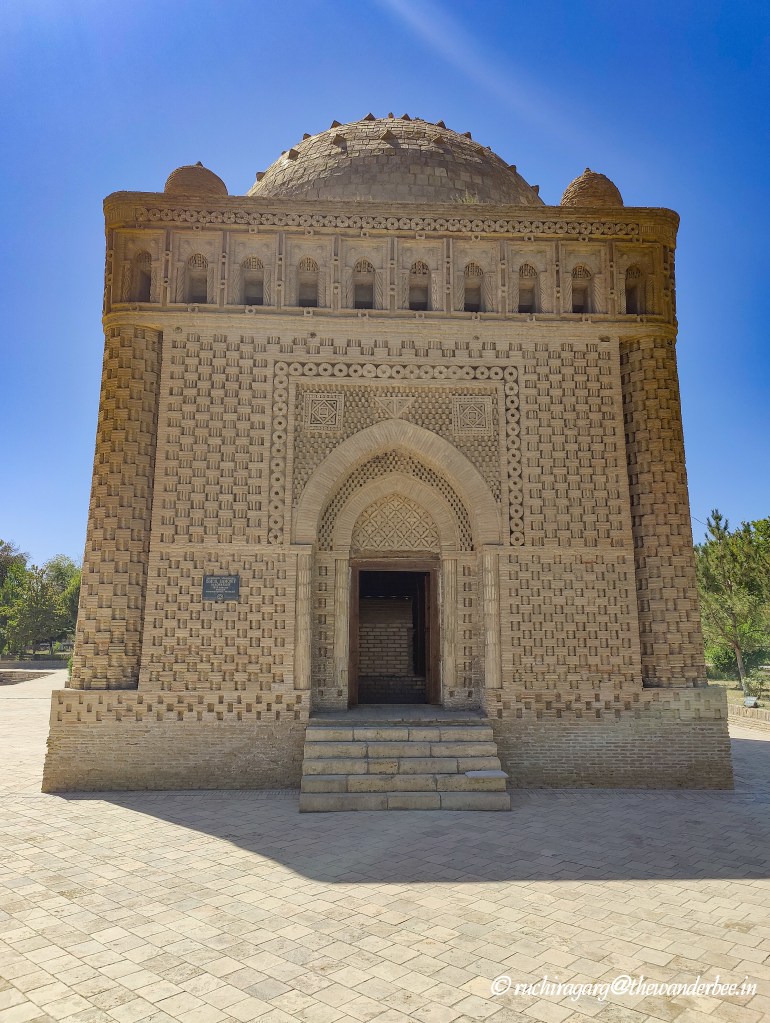
Our last stop was the famous Samanid Mausoleum. This mausoleum is considered one of the iconic examples of early Islamic architecture and is known as the oldest funerary building of Central Asian architecture.
- Central Bazaar:
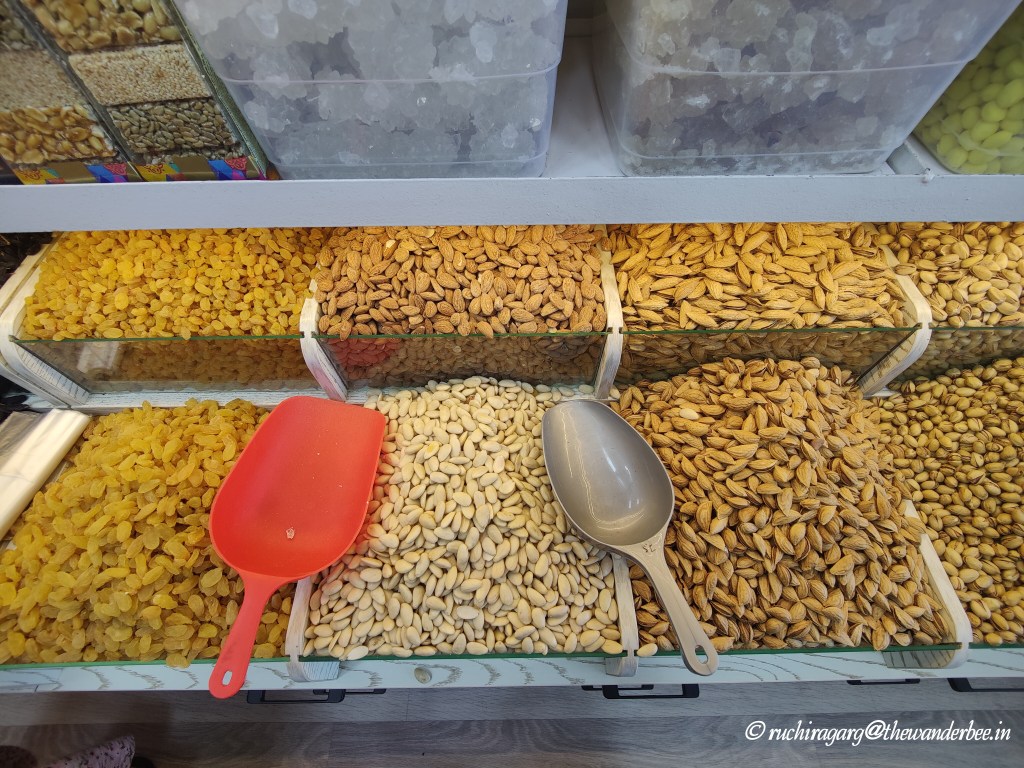
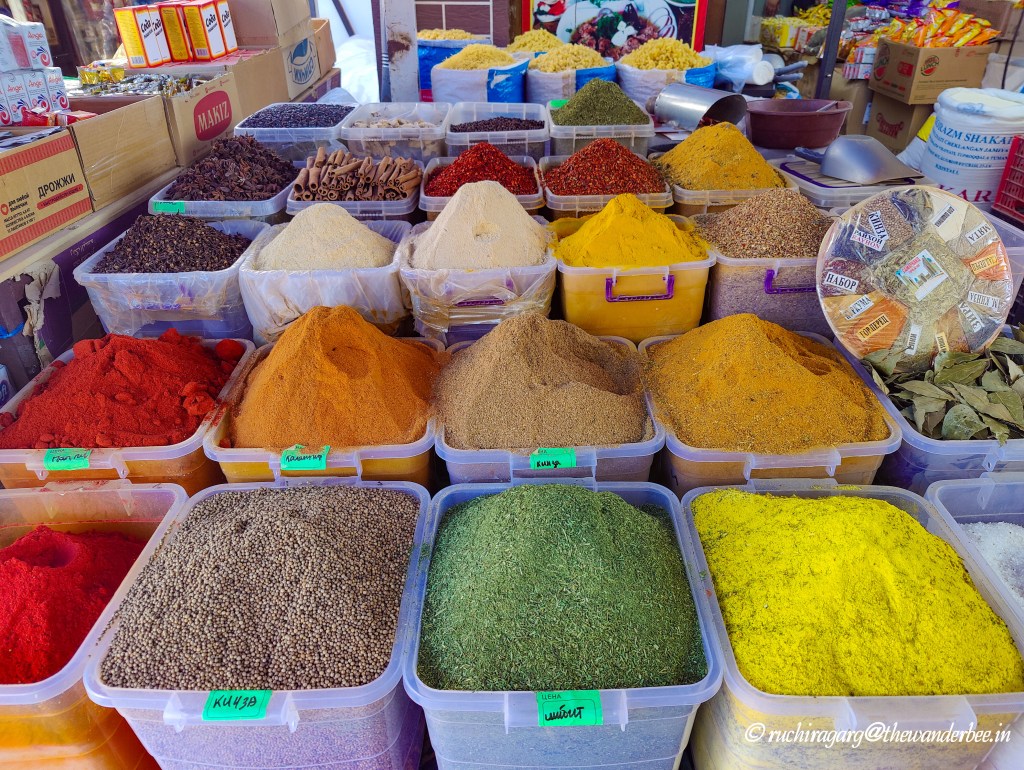
A few minutes walk away from the Samanid Mausoleum was the local market or Central Bazaar. We were welcomed warmly in one of the dry fruits shops and treated to loads of Bukhara Halva of different flavours. The size and quality of the dry fruits and the Bukhara Halva compelled us to buy some to take home for our loved ones as a mark of this ancient city.
While delving into the rich cultural tapestry and history, we uncovered fascinating trivia and noticed striking parallels with Indian customs. Similarities were evident in how marriages were arranged: the groom’s family sent gifts wrapped to the bride’s family, and the decision was signaled by whether the gifts were exchanged or returned untouched. We also observed similarities in the concept of dowry, where the boy’s family provides a house and the girl’s family contributes to furnishing it. But thankfully they are also now moving away from it and focusing on educating their children to fill up their own house so parents can enjoy their life.
In their culture, the youngest or only son traditionally lives with his parents, differing from India where this responsibility often falls on the eldest son.
Certain rituals intrigued us, such as placing honey in a newborn’s mouth for sweetness and money in their hand for prosperity. Similarly, like Hindu customs, they avoid rocking an empty cradle.
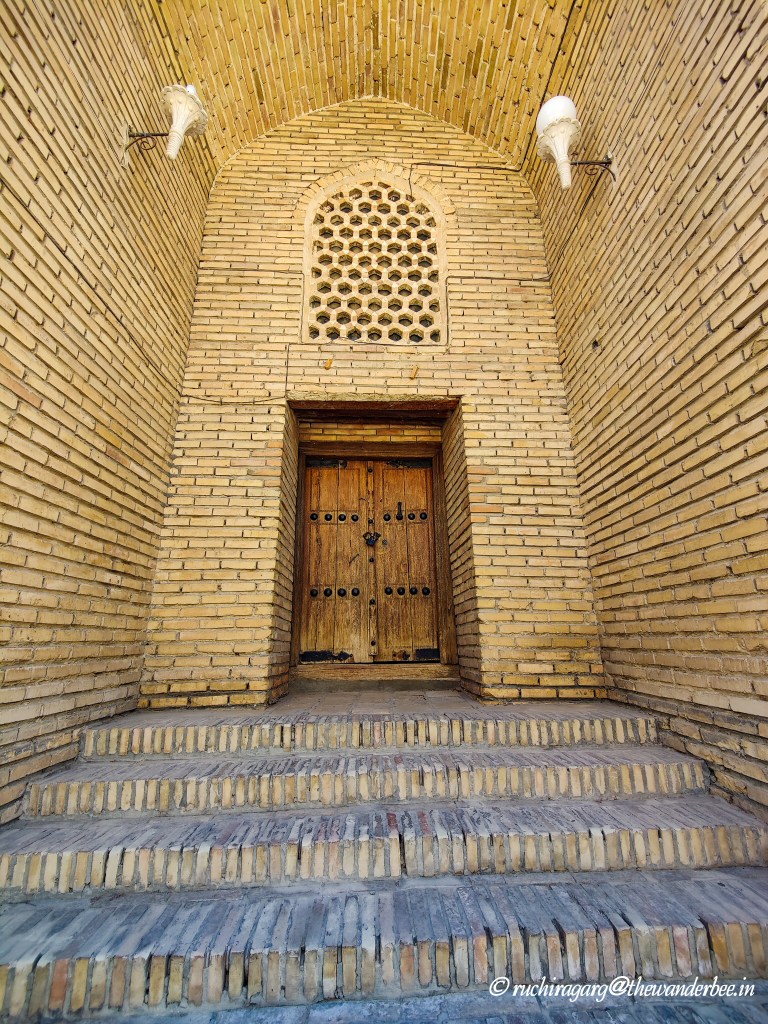
However, some insights were sobering. Bell sleeves, rather than a fashion statement, were historically used to cover a woman’s face if unexpectedly exposed to a man without a paranji (burqa). Another revelation was the color-coding of the paranji based on age, which served as a visible indicator of a person’s age. The Baghdadi doors we had been admiring were knocked differently by men and women. The knocks were different so that when a man knocked, the males of the house would open the door and when a woman knocked, females would open. If there was no man in the house when a male guest knocked, it was a signal for women to cover themselves and then open the door.
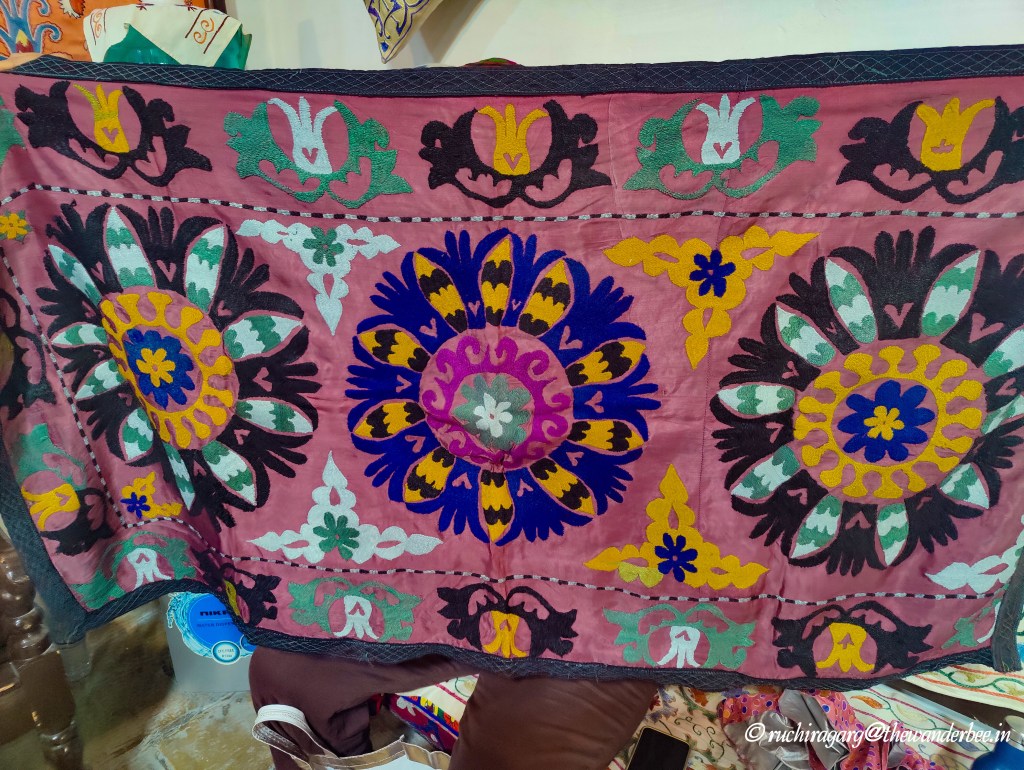
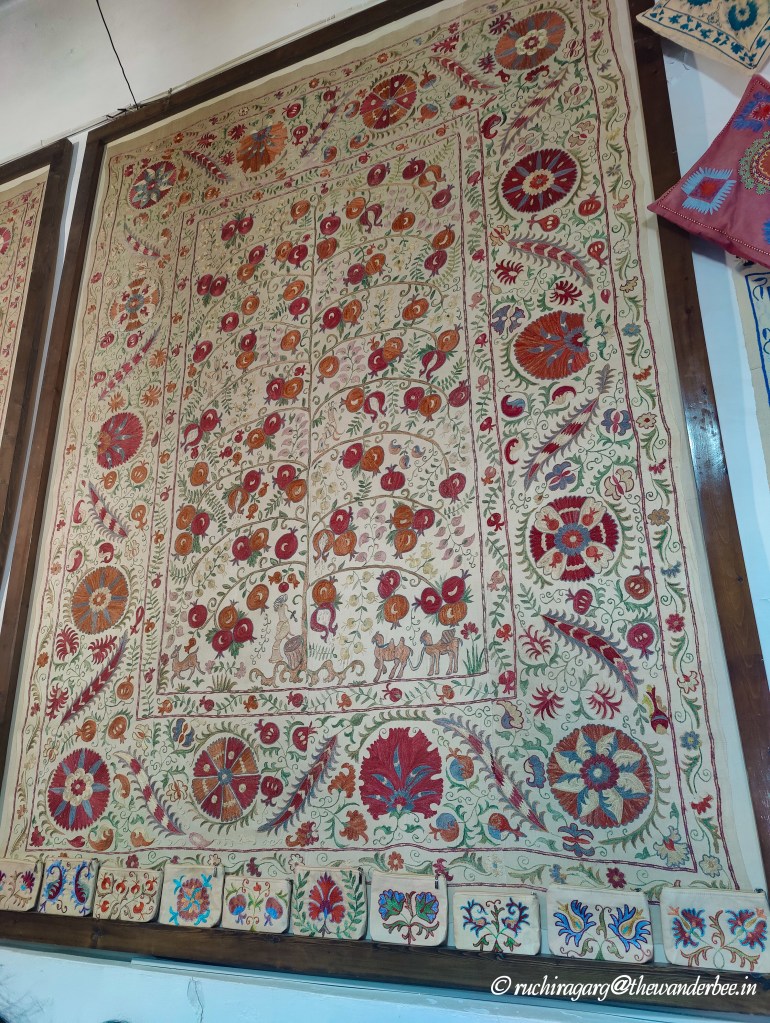
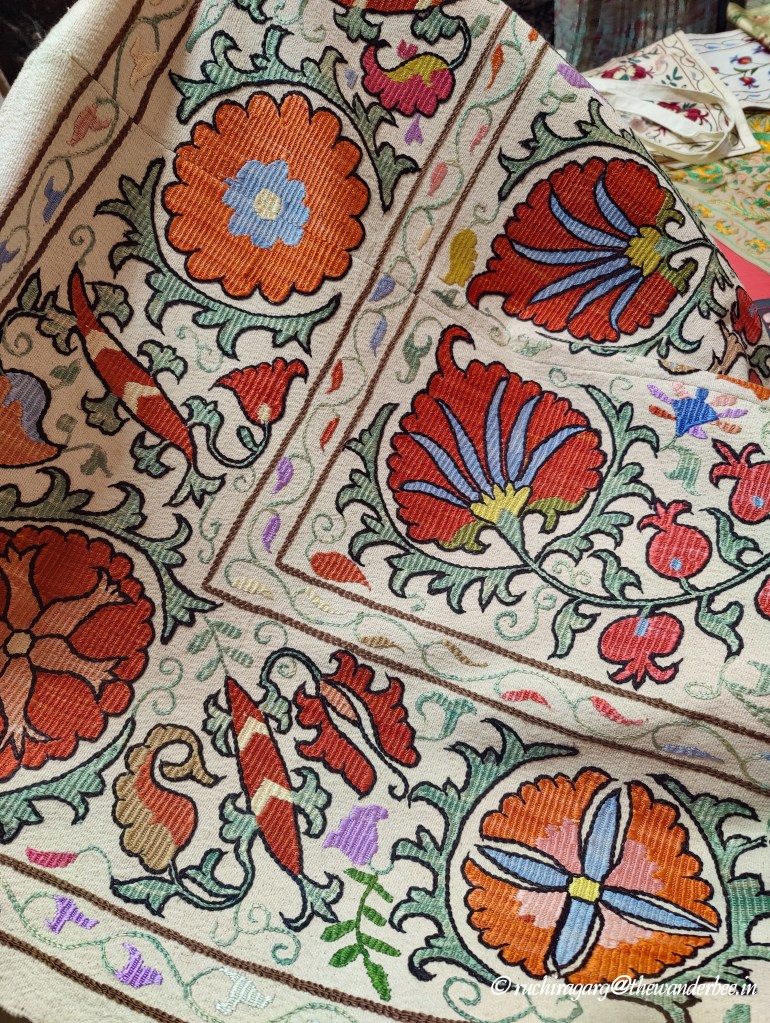
We discovered Uzbekistan’s rich embroidery tradition, boasting eight distinct schools of needlework. The stunning array of stoles, mats, bags, bedcovers, and wall hangings adorned with unique handiwork left us awestruck, particularly considering their affordability.
Restaurants I would recommend in Bukhara ( click on name for detailed reviews):
While each of the restaurants above served traditional Uzbekistani food, the ambience at the Lampa Alladina was more enjoyable with the traditional performances by the artists.
SAMARKAND :
Our last destination in Uzbekistan was Samarkand. The two hour train journey from Bukhara to Samarkand was more manageable. Unlike the historic and traditional Bukhara, Samarkand came across as a very modern city despite having 67 monuments as we were informed. Our hotel, the Mallika Prime was located next to the Amir Temur Park and was at walking distance to other monuments.
Sights we visited in Samarkand:
- Amir Temur Park:
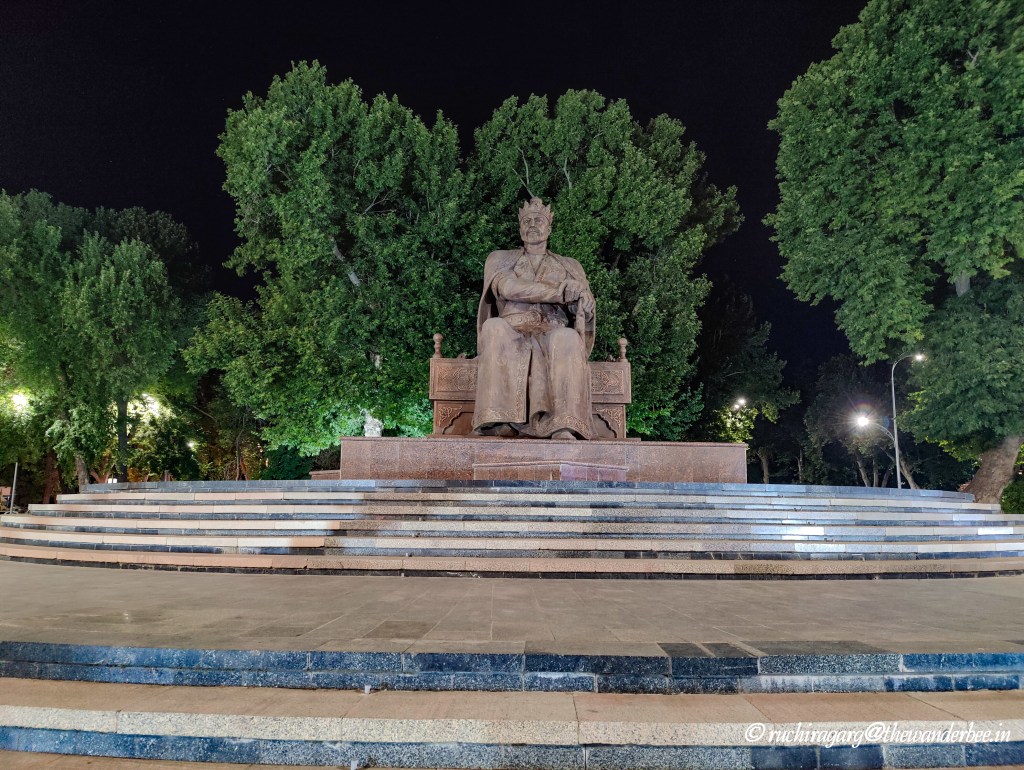
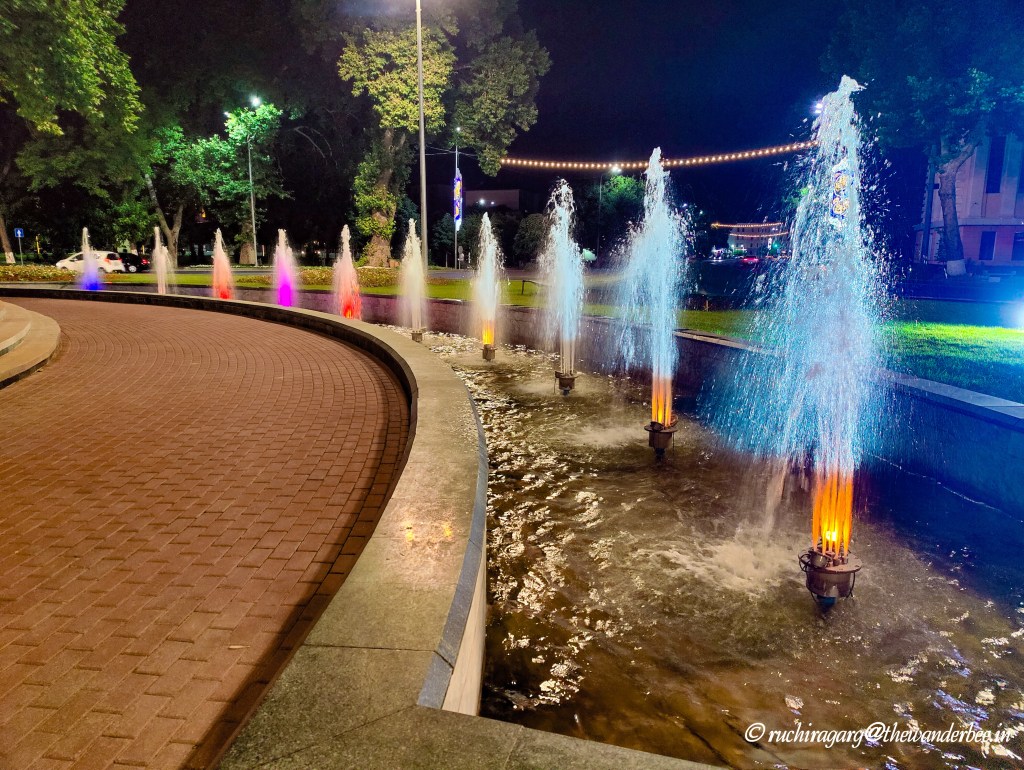
This park seemed to mark the city center with its lush green gardens, fountains and statues. The huge statue of Temur was situated centrally and the surrounding fountains made it a hub was walkers to stop by for a break. The park was illuminated through the night and we saw residents thronging it at all hours. It was right next to our hotel and we enjoyed our walk there in the cool breeze at night.
- Amir Temur Mausoleum Gur-i Amir Сomplex:
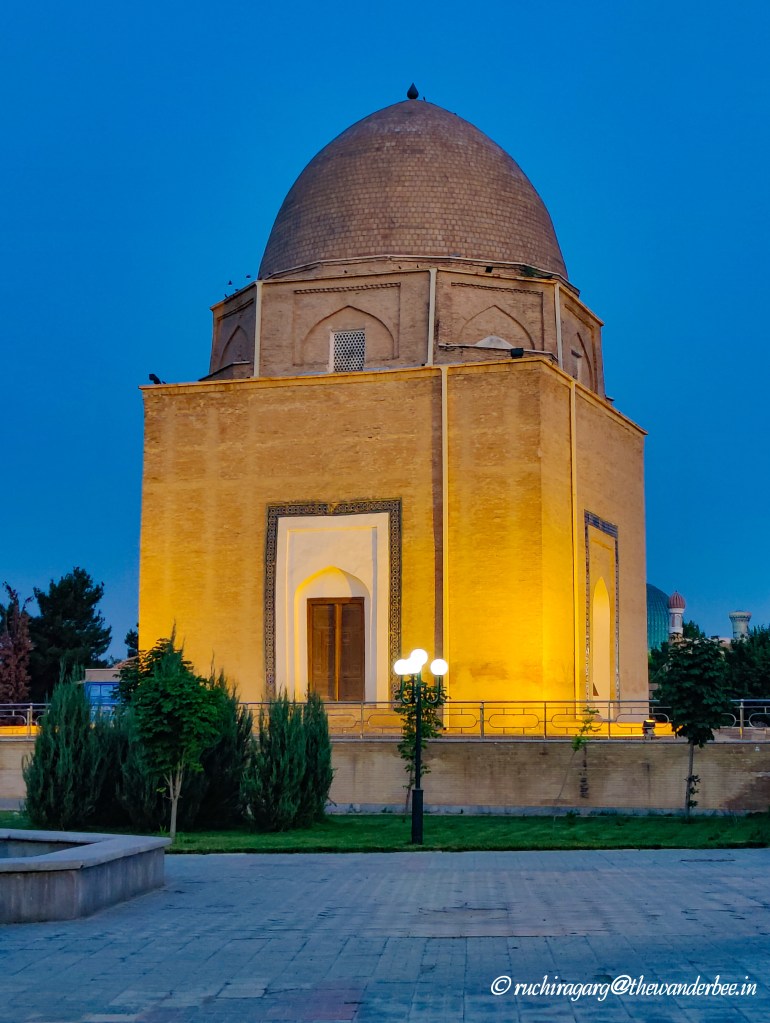
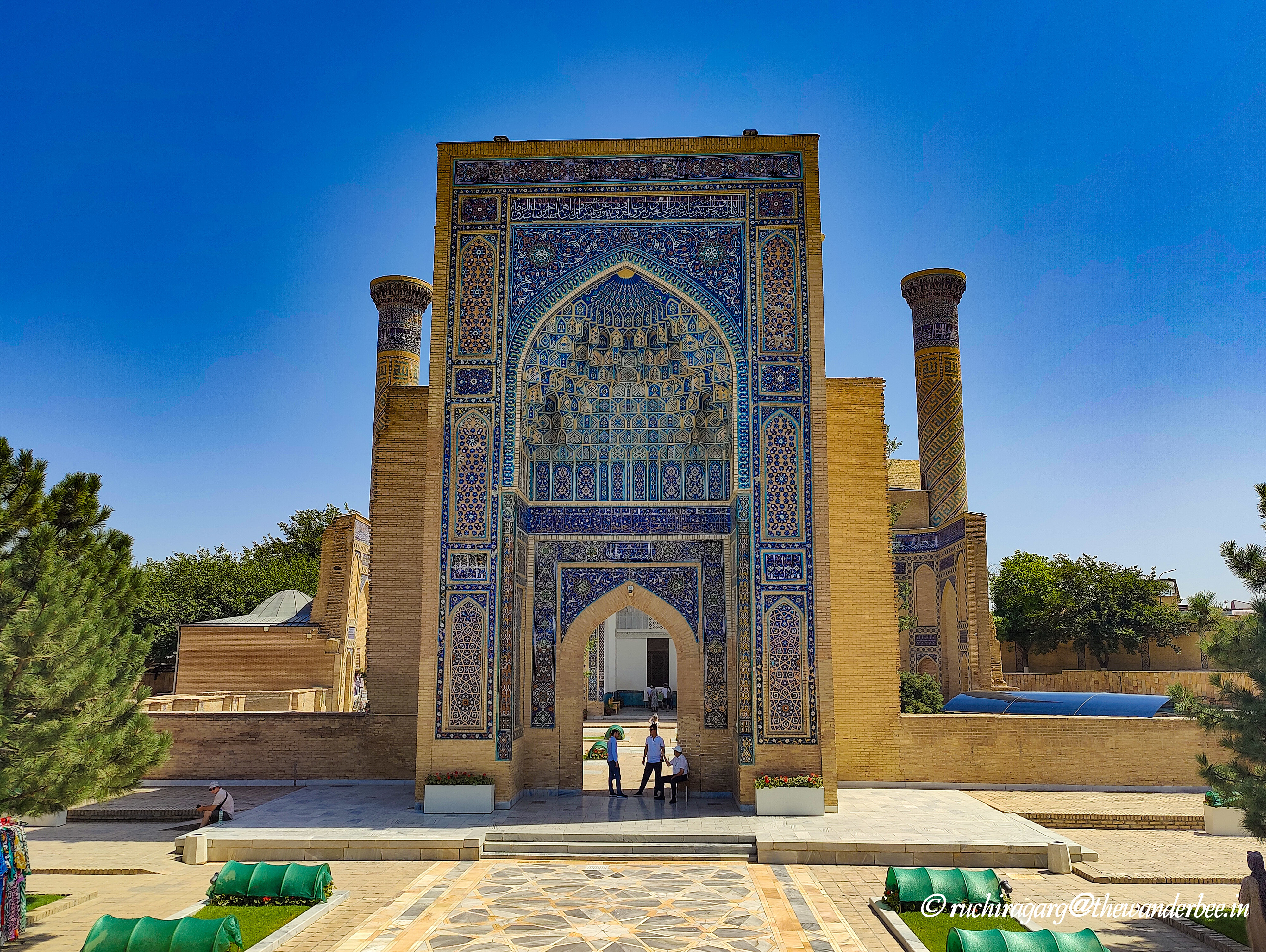
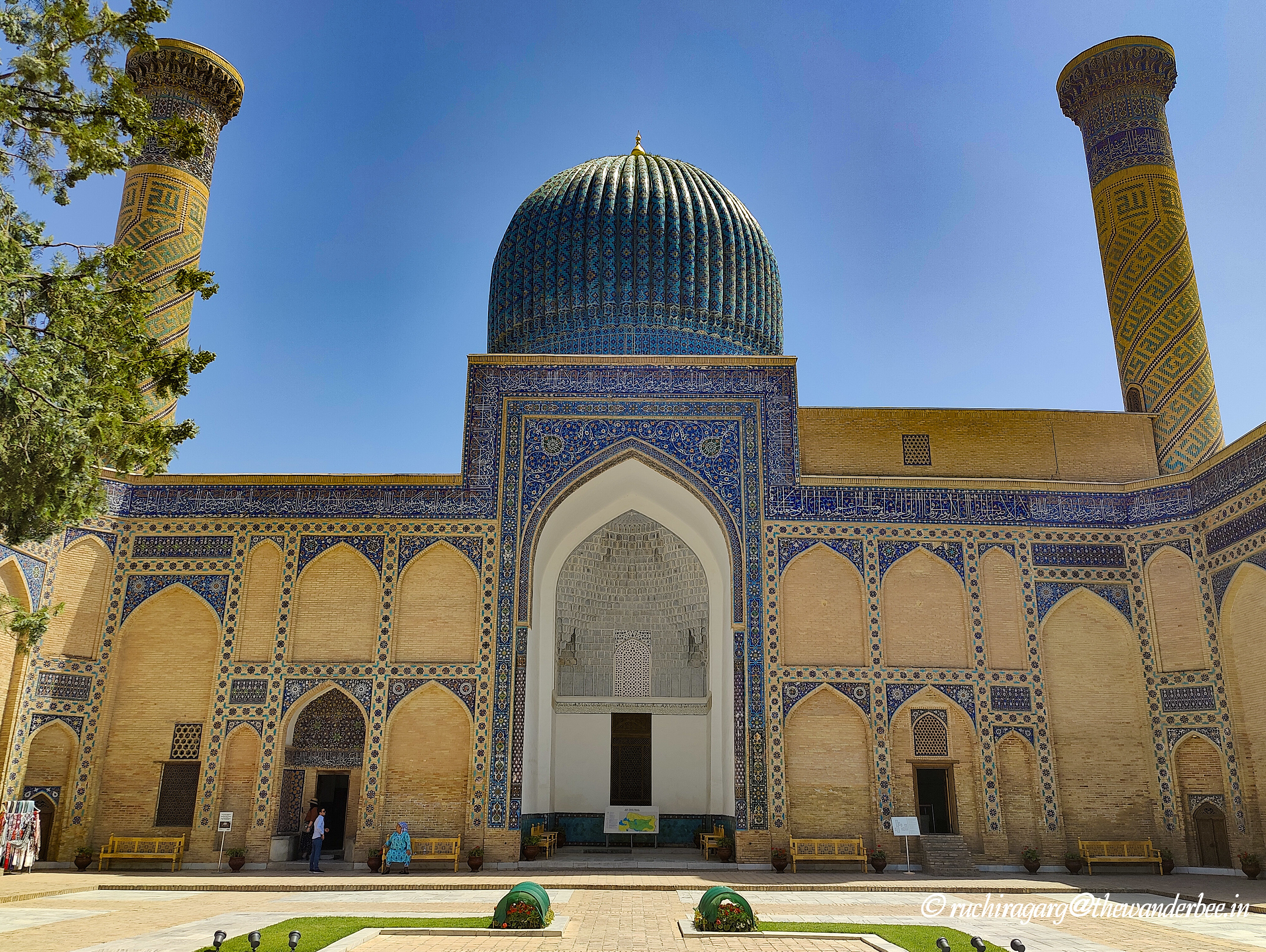
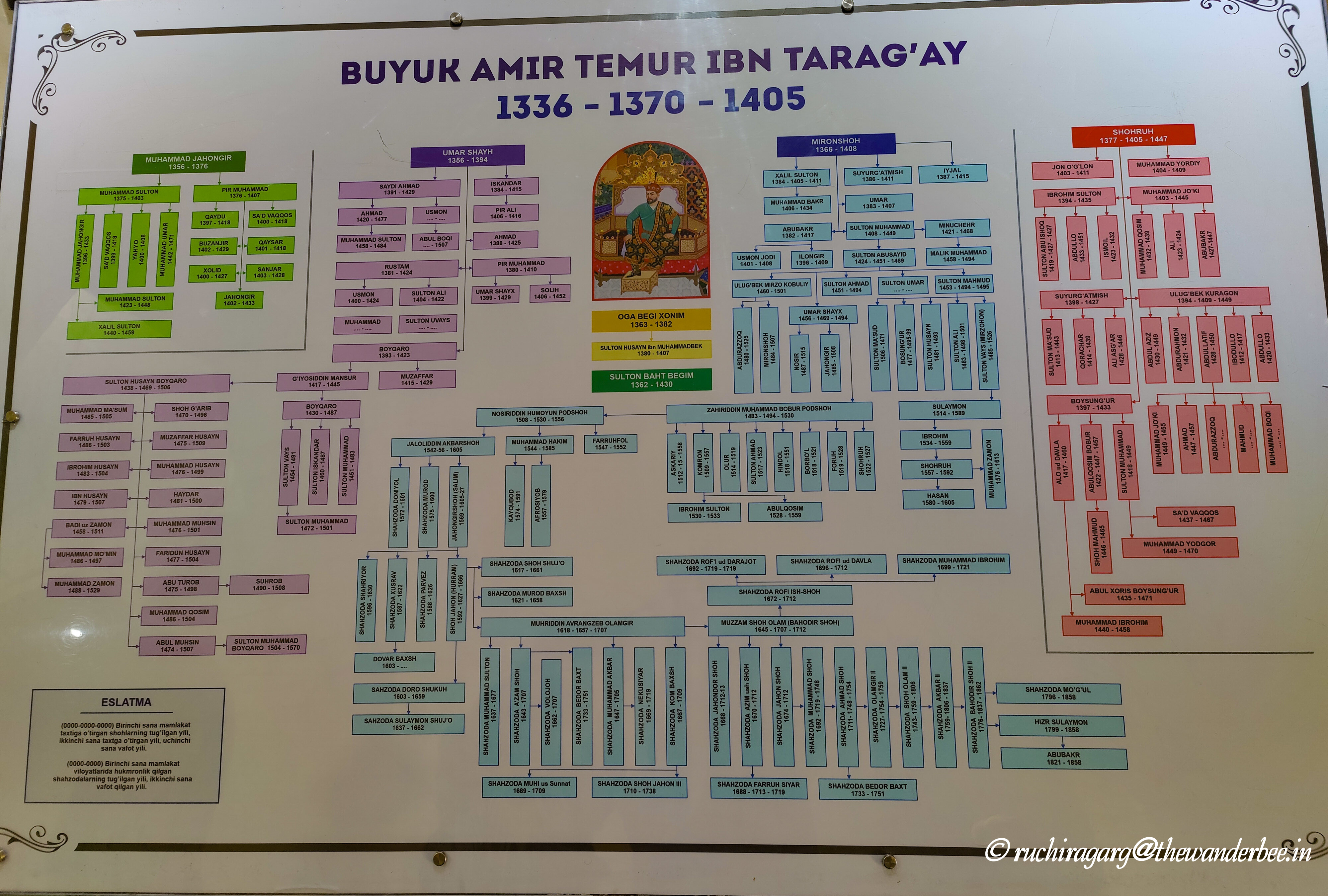
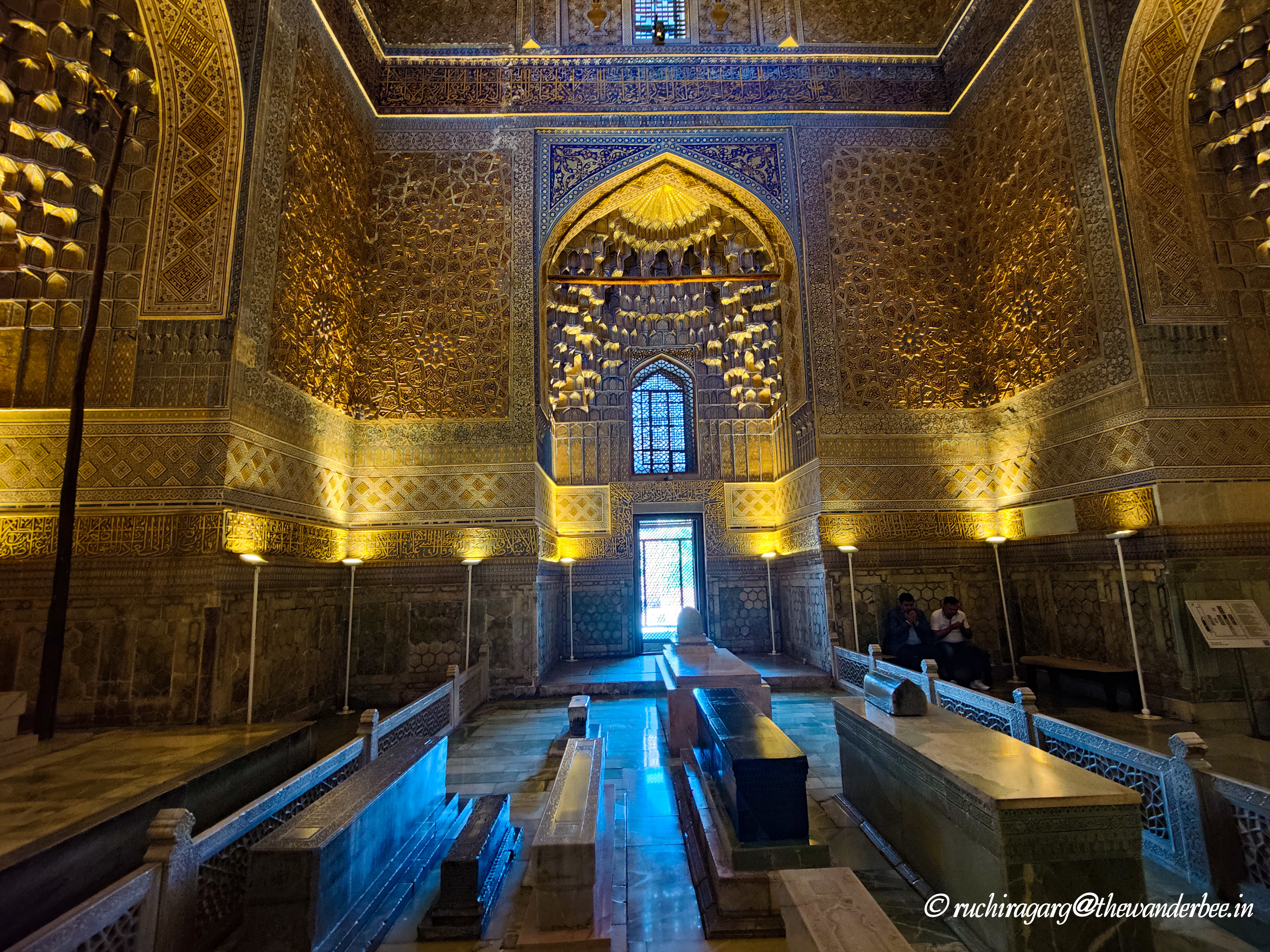
Gur-e Amir, translating to ‘Tomb of the King’ in Persian, houses the tombs of Tamerlane, his sons Shah Rukh and Miran Shah, and grandsons Ulugh Beg and Muhammad Sultan under its azure dome. Additionally, Timur’s teacher Sayyid Baraka is also commemorated within this architectural complex. The complex is impressive and is considered to be the precursor influencing the construction of Humayun’s tomb in Delhi and Taj Mahal in Agra. The interiors are magnificent and we learnt finer details like the reason why there was horse hair put up on a pole next to Sayyid Baraka’s grave. Hair of a horse put up near a grave indicates that it is the grave of a prophet, a saint or a highly respected person. The dome of the mosque has 63 spokes aligning to age of the prophet and the color blue was used on the dome as Temur’s throne was blue. We also got a glimpse of the overall Mughal family tree from which the Mughal dynasty that ruled in India had emerged. After a great lesson in history that we could all relate to, we proceeded onwards to other monuments.
Registan Square:
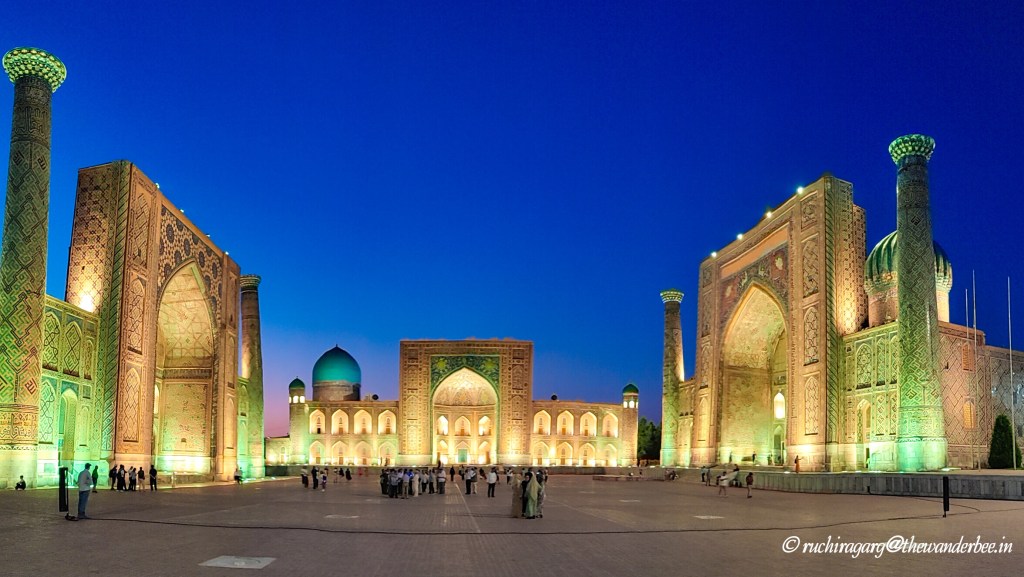
This is Samarkand’s most mesmerizing architectural ensemble, often featured in countless social media posts and reels. Once the bustling heart of the city, it served as both a venue for royal announcements and public executions. Bordered by three distinctively Persian-styled madrasahs, the square epitomizes the Timurid Renaissance. Constructed between the 14th and 16th centuries, the madrasahs include Ulugh Beg Madrasah, Sher-Dor Madrasah, and Tilla-Kori Madrasah.
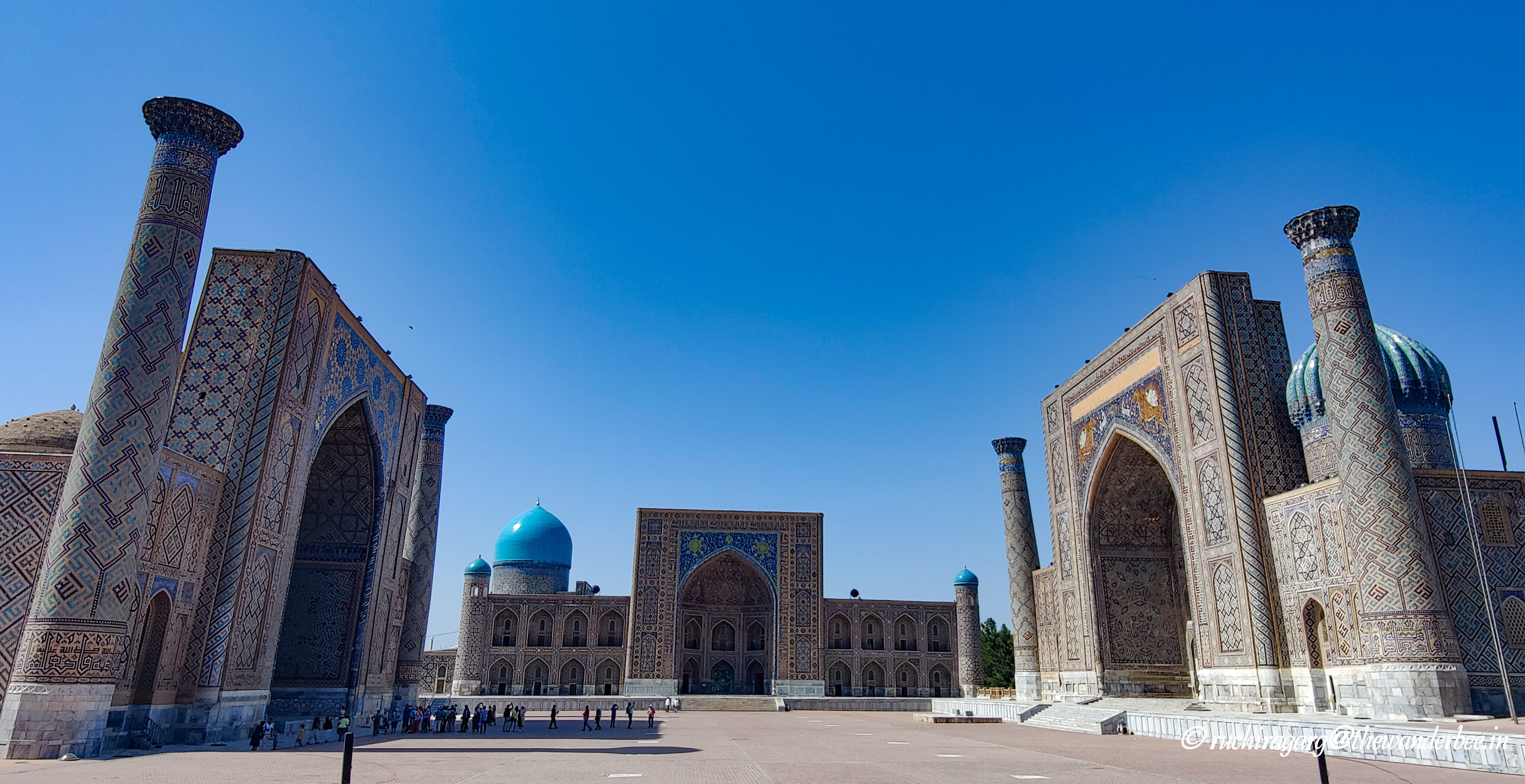
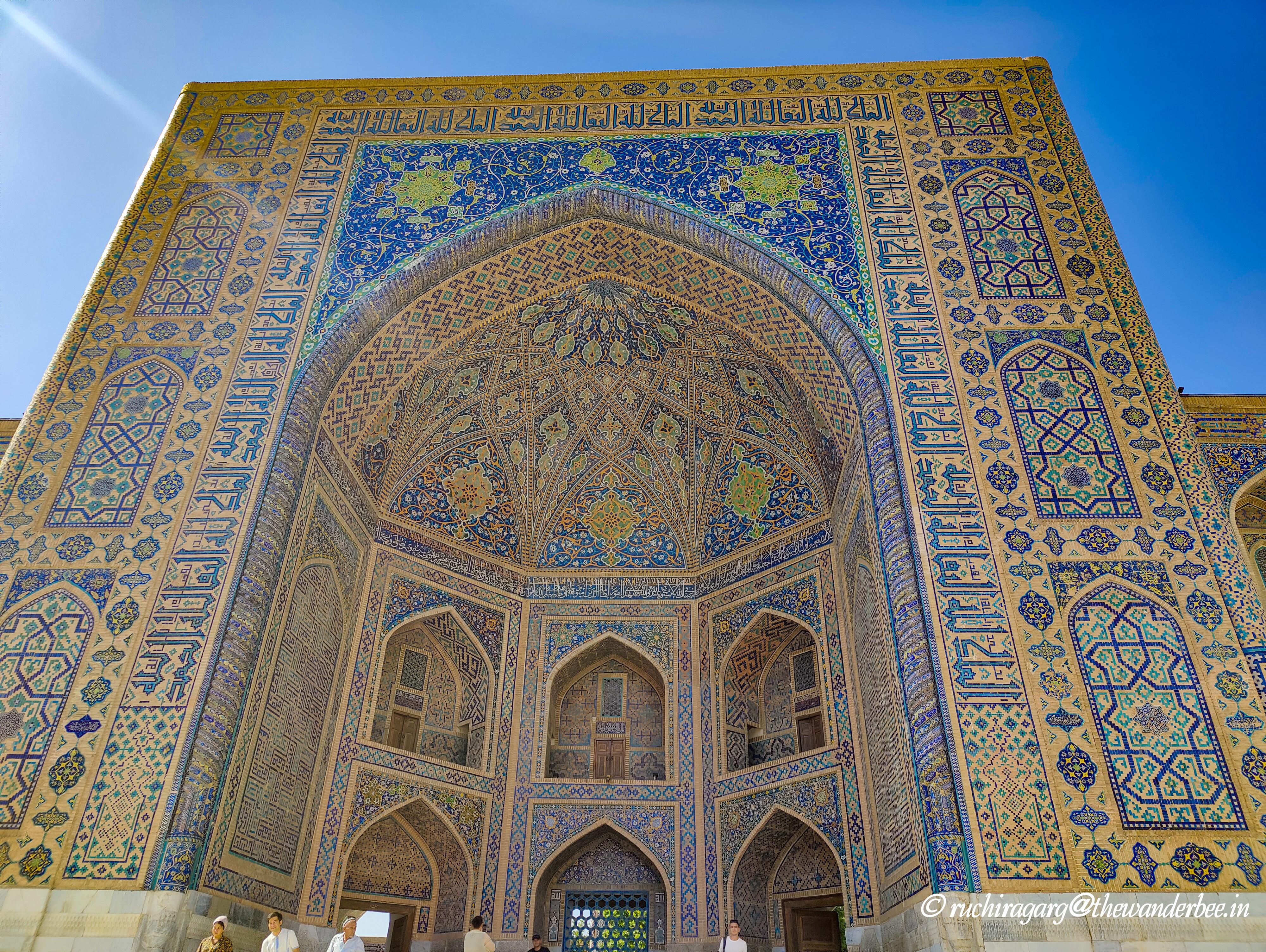
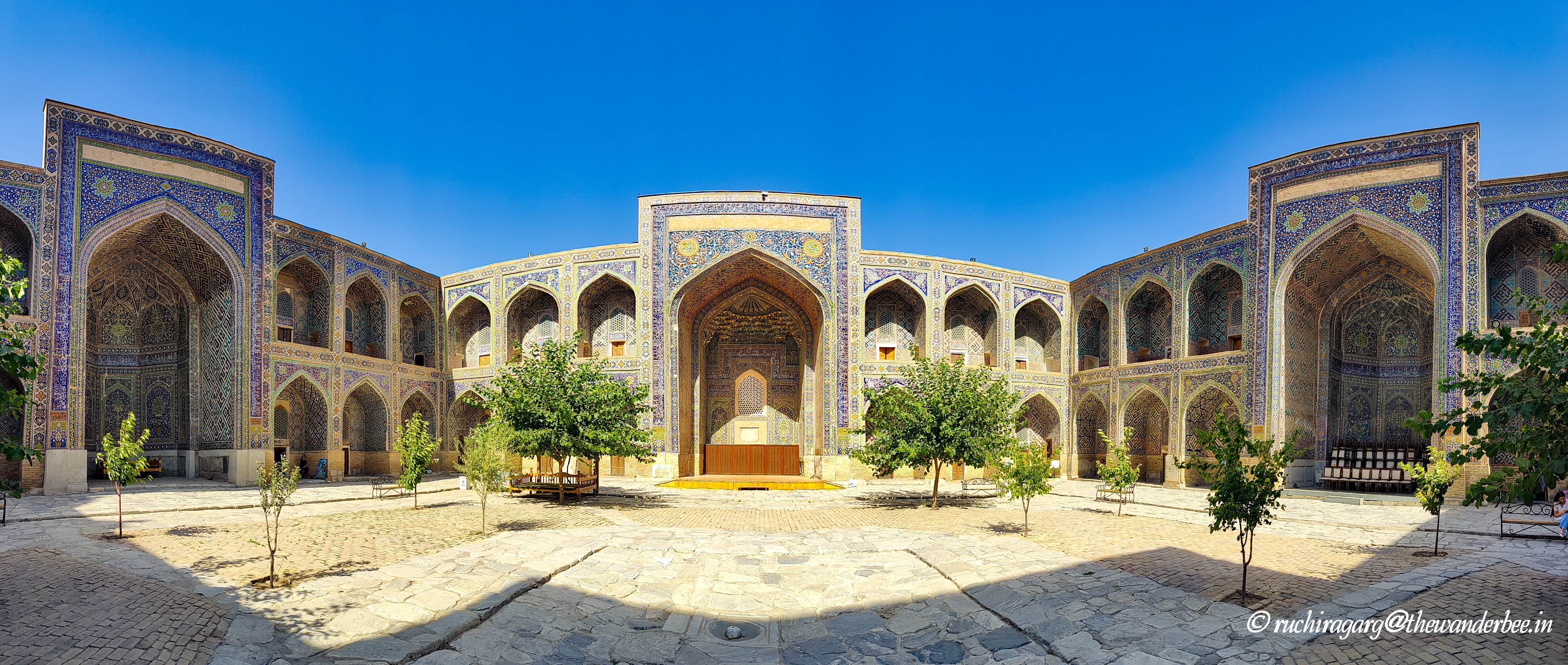
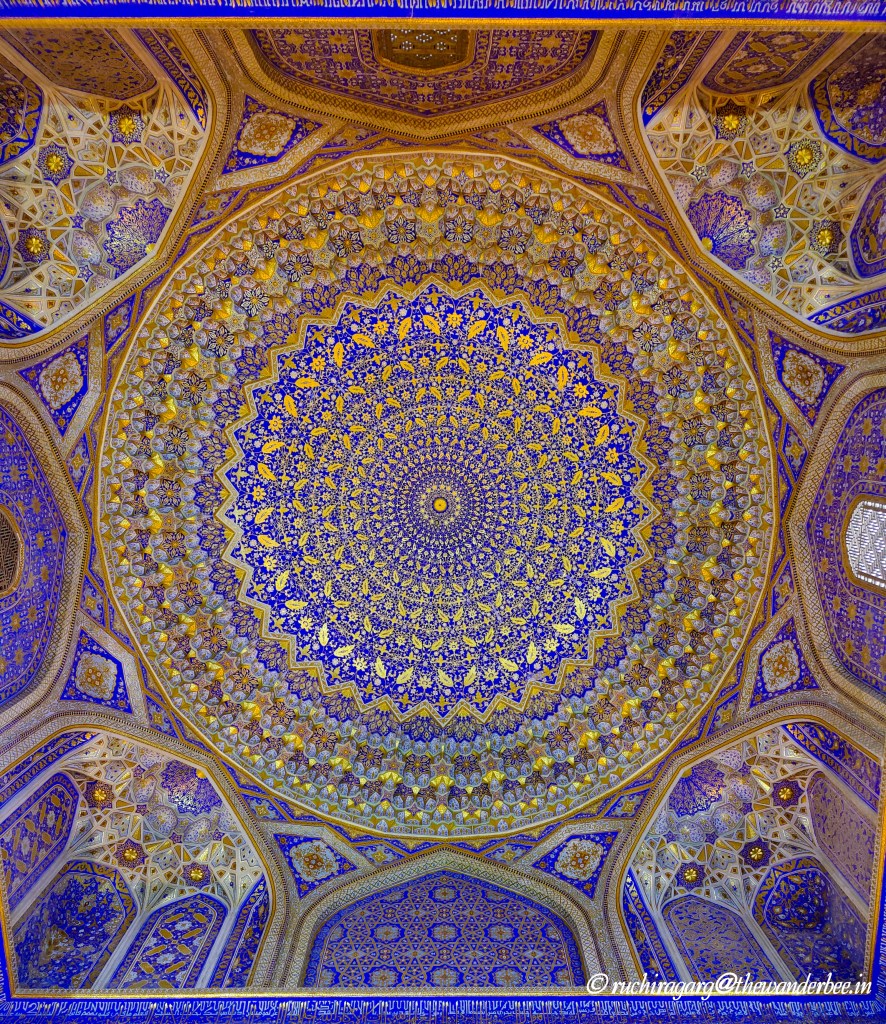
What really stood apart for me was the interiors of the mosque inside the Tilla-Kori Madrasah. There is a ticket for entering the main square and the madrasahs. Magnificent shades of pink, blue and golden and beautiful carvings left us gaping at them in awe. The ceiling of the mosque beautifully depicts the circle of life. Would recommend going inside each of the madrasahs for a view of the amazing interiors.
We went back to Registan Square at night to see the light and sound show that begins at 9 p.m and it was buzzing with people. It’s a hub for local people for enjoying their evenings specially families and small children. You can watch the light and sound show for free and it’s worth it. There are a lot of restaurants nearby to enjoy your dinner as well.
- Shakhi Zinda Ensemble :
Though not originally included in our itinerary, this monument recommended to us by the locals, turned out to be the highlight of our trip to Samarkand. The Shakh-i-Zinda Ensemble ( also known as Shah-i-Zinda) features mausoleums and ceremonial structures dating from the 11th to the 15th and 19th centuries. Its name, Shah-i-Zinda, which translates to “The Living King,” stems from the legend of Qutham Ibn Abbas, a cousin of Muhammad, who is buried here. Qutham Ibn Abbas arrived in Samarkand during the 7th century Arab invasion to spread Islam.
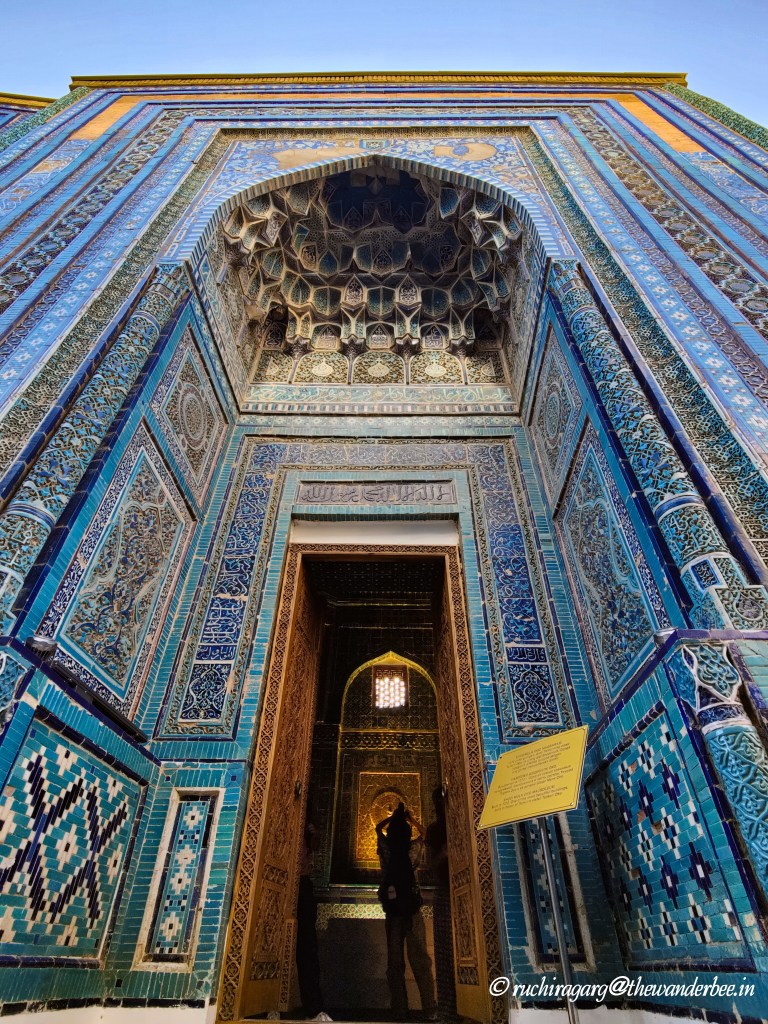
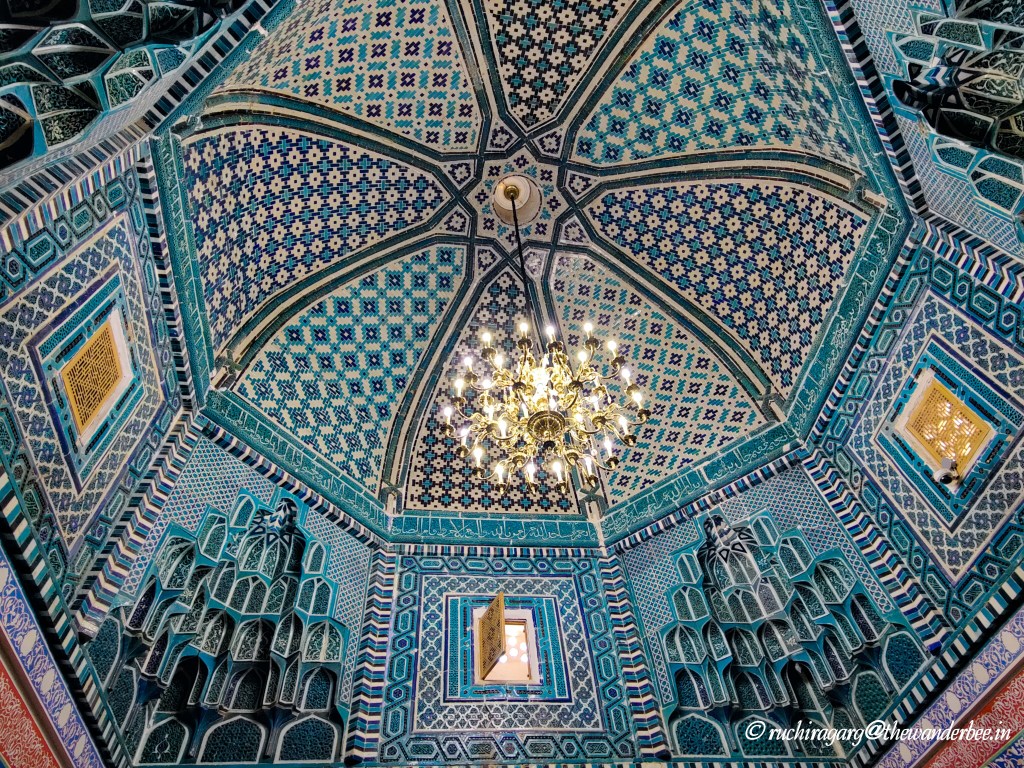
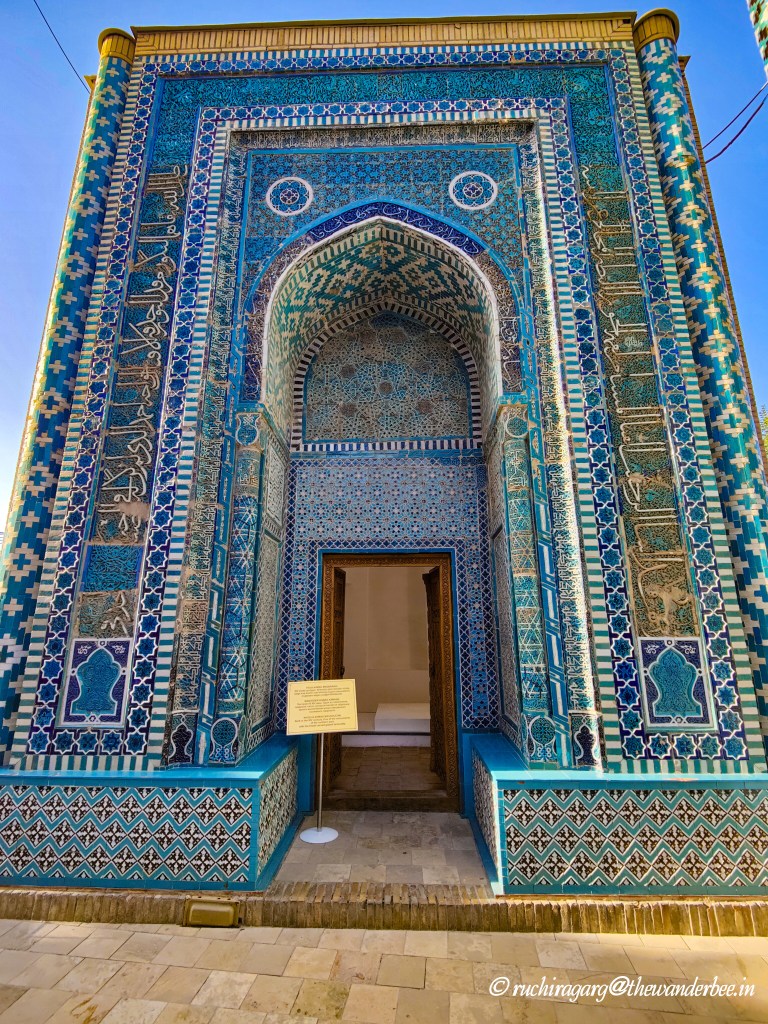
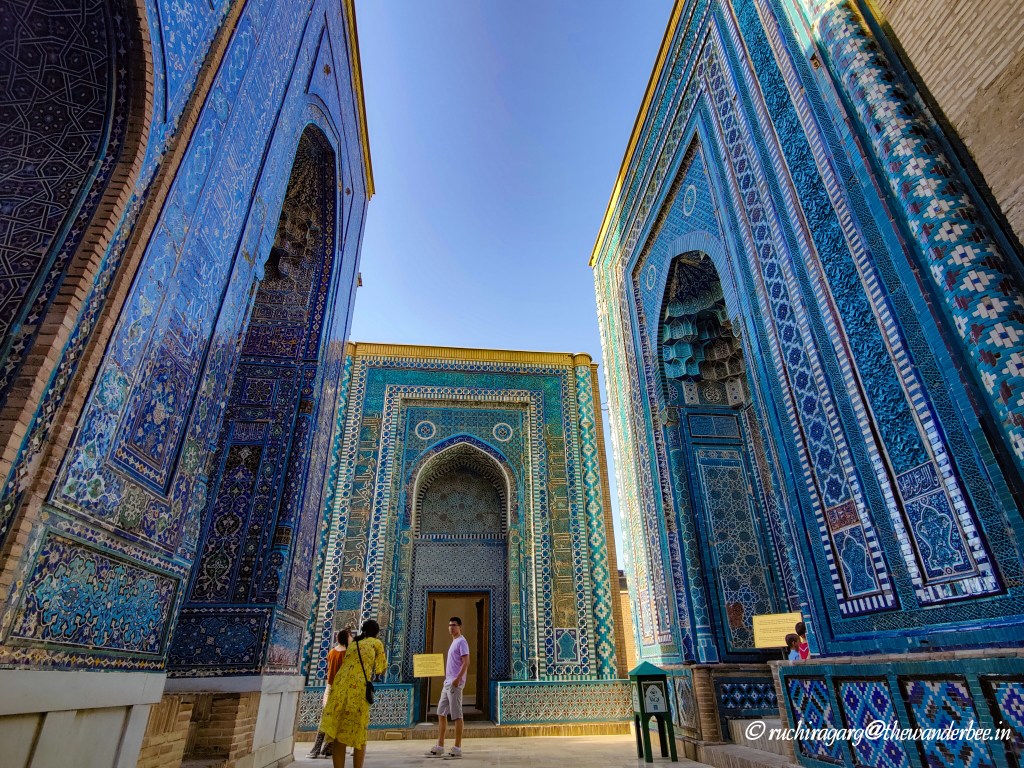
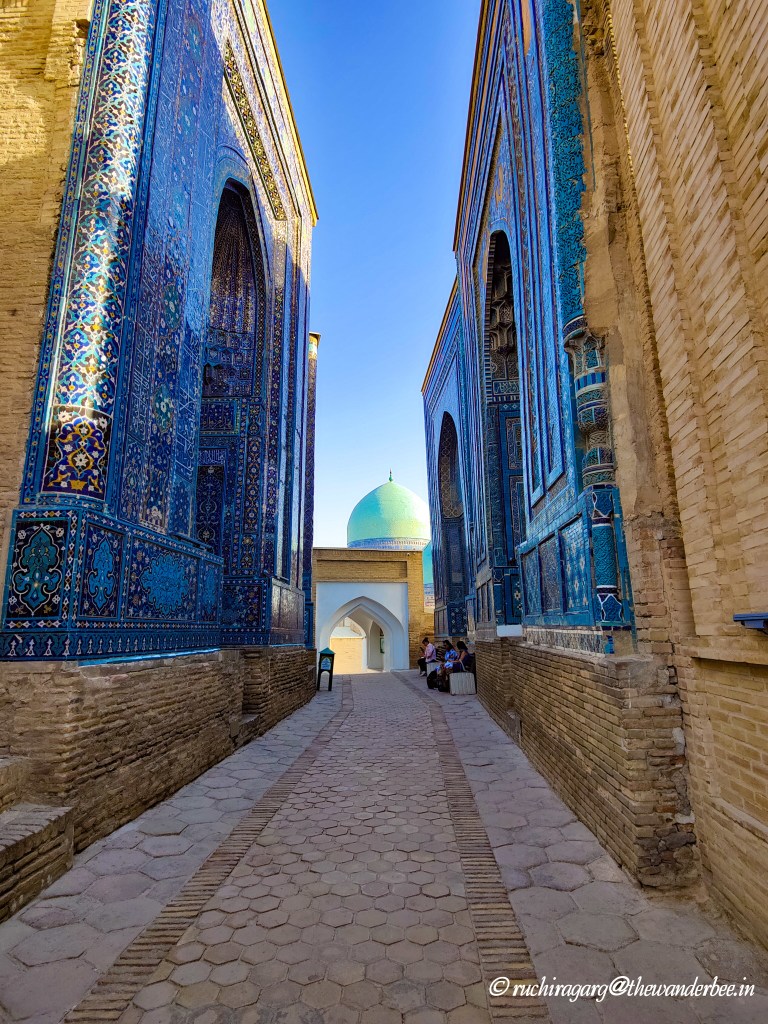
Spanning over eight centuries, the Shah-i-Zinda complex now encompasses more than twenty buildings, evolving into a significant historical site. The buildings are designed in different shades of blue with gorgeous engravings. They have been maintained very well and would recommend everyone visiting Samarkand to go there. One has to climb 36 stairs to reach the entry of the monument and it is not accessible on wheelchair so not recommended for those with mobility issues. There is a small market area outside so you can also pick up some souvenirs here.
- Siyab Market :
This was one of the local markets in Samarkand very close to the monuments. As with other markets, it was quite well organized and easy to navigate with multiple shops selling the same things. One can bargain easily here specially for clothes. However I found the quality of the stuff in the markets of Bukhara much more superior to Samarkand.
Places to eat: There were two restaurants at Samarkand that we really enjoyed dining at both for the quality of the food and the ambience. Click on the links below to read my detailed reviews about them.
Having travelled extensively across various countries, Uzbekistan stands out to me as one of the most captivating destinations, especially for its rich architectural heritage and vibrant culture. The warmth and fascination that locals showed towards Indians and Bollywood were truly heartening. We were often approached by Uzbek residents who eagerly took photos with us upon learning we were from India. Despite the stark linguistic differences, this camaraderie bridged any gaps and created meaningful connections with everyone we encountered in Uzbekistan.
The country felt incredibly safe, even late at night, with bustling cities where people comfortably walked the streets. Unlike many places around the world, we didn’t notice a significant presence of migrants; even in Indian restaurants, the staff consisted entirely of locals, which preserved Uzbekistan’s original culture while maintaining a liberal atmosphere.
The welcoming atmosphere extended beyond locals to fellow tourists, particularly Indian travellers. It was common to meet and strike up conversations with other Indians, exchanging stories and experiences, which added to the overall warmth and hospitality of Uzbekistan.
Every traveller should have Uzbekistan on their bucket list; it’s an experience not to be missed!
A few things to keep in mind:
- Washrooms were not available at all monuments so plan your day accordingly.
- Most monetary transactions were done in cash and only restaurants accepted credit cards. That too mostly visa and mastercards so do carry cash with you.
- ATMs are available in shopping areas though not in every nook and corner
- GPS is not very accurate. There were a number of times we went round and round a place. Keep google translator handy if you have to ask around though most people were able to speak a little English
- You may be required to cover the head in functional mosques and madrasahs so carry a scarf and shorts are not recommended.
- 2 p.m to 4 p.m is the hottest time in summer so avoid visiting monuments at this time.
- In most restaurants we visited, though they said they were individual portions, the quantity was beyond one person to finish specially. So check specifically with the attendant when you order.
- Practically all restaurants had service charge added of 15-20%.
- Uber does not ply in Uzbekistan. Their local app based taxi service is Yandex. You can download the app from apple store or google play store. Be mindful that the app GPS does not work very well and your cab may wait for you or drop you a few minutes walk away from the intended spot. There are also waiting charges if you get delayed in reaching the cab beyond 10 minutes. Given the language challenges, for those on a short holiday, a prebooked travel itinerary with personal transport would be more effective.
- The currency exchanges only accept large currency notes. They do not exchange notes below 5000 som, so if you have small change, please spend it before you leave the country.

 The Wanderbee